
 Please be advised that the following article discusses rape allegations.
…
The New York Times has terminated their contract with author Olivia Waite, their romance columnist, after she reposted Mark Jacob’s repost of Marisa Kabas’ criticism of the Times’ coverage of new rape allegations about Trump.
That is a sentence I didn’t think I’d type today. Or ever.
To get the full picture, we need to start with the recent House Judiciary Democrats’ report that included new allegations of rape against Trump.
No, really.
Last week, independent journalist Marisa Kabas (The Handbasket) shared that she emailed Patrick Healy, the assistant managing editor for standards and trust at The New York Times, “to ask why their story about a House report with new details of rape allegations against the President of the United States included neither those details, nor a single use of the word ‘rape.’”
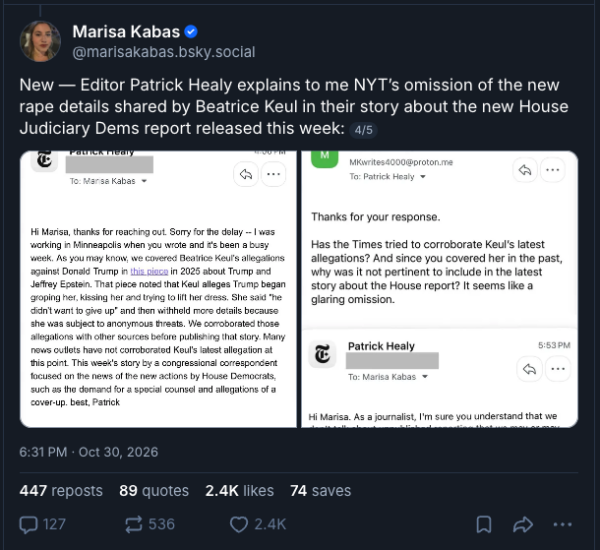
Kabas later shared Healy’s reply, which attracted substantial attention from the 440+ people who reposted it alongside the 2.3k people who liked it.
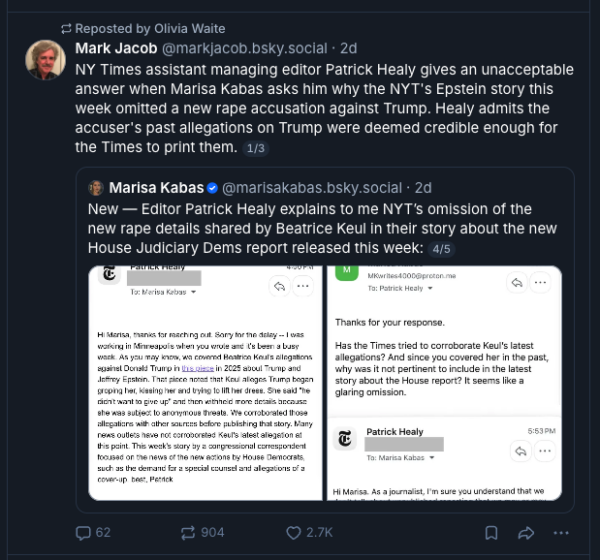
Journalist Mark Jacob, former metro editor at the Chicago Tribune and author of the Stop the Presses newsletter about right-wing extremism in America, reposted a part of Kabas’ thread with commentary, which Olivia then reposted on her feed.
Jacob wrote, “NY Times assistant managing editor Patrick Healy gives an unacceptable answer when Marisa Kabas asks him why the NYT’s Epstein story this week omitted a new rape accusation against Trump. Healy admits the accuser’s past allegations on Trump were deemed credible enough for the Times to print them.”
Then came an email from Tina Jordan, editor of the Book Review, saying that Olivia’s clear sentiments about the Times mean that the paper is no longer a good fit for her column.
Like Olivia, I have also written about romance for The New York Times. I have a framed Times article on my wall from 2007 and clippings of the articles and book round ups I’ve written. But even more exciting and impactful was that the NYT covered romance at all. A column just about romance? In the New York Times?!
If you’d told me that 20 years ago, I’d have snortlaughed myself into a sinus infection. It has been a LONG road to mainstream coverage, let alone respect. When they brought Olivia on as the romance columnist, I was genuinely excited for all of us.
But it’s shocking, appalling, and outrageous to see them dismiss a fiction columnist for sharing someone else’s post criticizing coverage of rape allegations against Trump.
This news is one spinning leaf in the tornado of nonstop mayhem this week, but wow, WOW, is it infuriating.
My first question was whether there were clear guidelines for social media for what the Times calls Nonjournalist Contributors. Their editorial standards for ethical journalism outline some requirements for Nonjournalist Contributors, but social media policies are not mentioned that I can see. So why was this the route chosen?
I think what makes me the most angry is the pretense that the Times is trying at all times to appear objective and neutral.
Codswallop. Objective fucking where? The Times’ coverage is often so slanted it could provide shade after sunset.
To quote writer David Singleton, who commented in a Times Insider chat (like an AMA) with Patrick Healy on 2 November:
“…the vibes are quite clear, given the bent of your coverage of the Alaska race, your ignoring the latest allegations against the sitting POTUS, and your paper’s overall treatment of transgender individuals.”
And with the lack of a public editor (the position was eliminated in 2017), there is little visible accountability for the Times’ decisions.
Olivia issued this statement to me (emphases are mine):
Last Thursday on Bluesky I reposted two of Marisa Kabas’ criticisms of the NYT’s coverage of the new rape allegations against the president. On Friday the Times declined to continue my contract as a fiction columnist, via a one-paragraph email praising the quality of my work but citing my presumably negative feelings about the NYT as inferred from my Bluesky posts, which they admitted they have been monitoring.
As a romance novelist and critic, I must professionally insist on the distinction between feelings and critique.
Romance writers often have to discuss sex and rape in professional contexts. The genre is fundamentally a decades-long conversation about how sexual consent is negotiated in a world where power is unequally accessed. These conversations are often fraught, and demand nuance. From vintage bodice-rippers to queer couples in historical eras to modern dark romance and romantasy, an author learns how to engage with scenes of physical intimacy and even sexual violence with a certain amount of detachment.
The detachment is only tenable so long as the violence remains fictional.
We should not be similarly detached when discussing real-life rape. This is not a subject on which even the most platonically objective journalist should aspire to neutrality. “Rape is a serious crime” is a factual statement.
One which the NYT avoided making: one of Kabas’s other statements, which I did not repost, pointed out the paper had not actually used the word “rape” when discussing the new House report alleging that a sitting president committed a crime of the most direct and selfish kind.
On the eve of a national midterm election, the Times reached all the way over to the Book Review and parted ways with a writer in the genre that most often presents rape scenes from the perspective of the victim, in stories that insistently end with the victim triumphant, beloved, and happy.
And it appears that the paper’s ideal of journalistic objectivity and nonpartisan stance consists of not naming rape allegations as such when they apply to a sitting president, on the eve of a national midterm election.
The email demurs that they would never ask me to censor myself on social media — but it’s hard not to view being let go so abruptly as retaliation for one of the most minor modern forms of speaking out.
They contracted me as a critic, and critical I remain. It’s true that nobody is owed a column or a platform for their opinions, no matter how expert. The gig came to me at someone else’s whim, and I always knew it would depart in the same sudden way. There is always mourning when an era comes to an end, but although I’m on the brutal peaks-and-valleys roller coaster of grief at the moment, I have no regrets.
When I asked what Olivia would like to happen, her reply was, as she put it, aspirational rather than pragmatic:
I want institutions to be at least as accountable as the people who work for them.
I want consequences to be proportional, and not just for romance writers.
And I want the safety and bodily autonomy of other people to always be a higher value than emotional detachment and objectivity. The value of being neutral depends entirely on what you’re staying neutral about.
The safety and dignity of human beings is what we cultivate journalistic objectivity for — it has no intrinsic value outside the ethical framework.


