
 3 months ago
24
3 months ago
24
The Nasdaq’s sudden lurch lower on Friday looked like a crack in a story that had seemed, until recently, almost bulletproof—the story that artificial intelligence is not merely a useful tool but a civilizational force, the kind of technological leap that justifies paying 1999 prices for 1999-style dreams.
Tech stocks led the worst market sell‑off since October, with AI‑linked megacaps shedding hundreds of billions of dollars in value in a single session. One catalyst was a stronger‑than‑expected jobs report, rekindling fears of Federal Reserve rate hikes and spooking President Trump himself. Broadcom’s recent weak guidance was another as the same chipmakers and cloud giants that had powered a year‑long melt‑up—Nvidia and the hyperscalers—turned into the day’s biggest losers, with traders questioning whether the AI boom can keep justifying tech‑bubble valuation multiples without the promise of imminent rate cuts.
But a handful of analysts and investors, along with JPMorgan CEO Jamie Dimon and Bridgewater Associates founder Ray Dalio, had been warning in the days and weeks before the screens turned red that something was looking off to them.
‘Yet another way in which 2026 is looking like 1999’
On June 3, two days before the market sell-off, Acadian Asset Management senior portfolio manager Owen Lamont posted on his Owenomics blog under the headline “A pessimistic take on optimistic growth forecasts.” He argued that the clearest sign of a bubble wasn’t necessarily price action, but the surge in the earnings expectations that justify it. He showed his math, too.
Since 1985, he calculated, analysts have on average predicted about 13% annual earnings growth for S&P 500 companies, while the realized figure has been closer to 7%. Drawing on research by Pedro Bordalo, Nicola Gennaioli, Rafael La Porta, and Andrei Shleifer, he said that good earnings growth in the present induces “irrational exuberance” among investors, who can’t help projecting those earnings forward. “Their findings suggest that shareholders will be disappointed over the next five years as earnings fail to grow as fast as expected, just as they were after the tech stock bubble,” he wrote.
Citing long-time stock watcher Ed Yardeni, the originator of the “bond vigilantes” phrase, Lamont noted that expected long‑term S&P 500 earnings growth hit 20.2%, exceeding 2000’s high of 18.6%. “Perhaps,” Lamont wrote, “when 2031 rolls around, we’ll look back and see today’s market valuation as another triumph of the efficient market hypothesis … But for me, today’s optimism is yet another way in which 2026 is looking like 1999.”
In his framing, the danger is less that the S&P 500 is “too high” in some abstract sense, and more that investors and analysts are once again getting out over their proverbial skis.
A divergent economy, outlined June 1
Two days earlier, on June 1, JPMorgan Asset Management’s chief global strategist David Kelly published his weekly note under the title “Investing in a Divergent Economy.” He sketched an outlook that, at first glance, sounded almost comforting: real U.S. GDP growth between 2.0% and 2.5% in 2026, easing to 1.5%–2.0% in 2027; unemployment drifting slightly below 4%; and inflation falling back toward 2% over the next year.
But those averages mask “many dimensions to the divergent trends playing out across the American economic landscape today.” Among them:
- Rich vs. poor. Drawing on work by Thomas Piketty and Emmanuel Saez, Kelly noted that the top 10% of U.S. households received around 50% of total income in 2022. Federal Reserve data show they owned roughly 62% of household assets, and total household assets stood near 630% of GDP—higher than before the dot‑com bust or the 1987 crash.
- Tech vs. the rest. The top 10 companies in the S&P 500—eight of them essentially tech names—now account for more than 41% of index market cap and 33% of earnings. Over the year through the first quarter, real GDP grew 2.6%, but real investment in equipment and research and development rose 8.9% and 9.3%, respectively, driven by a boom in hyperscaler capital spending. Kelly cited estimates that this capex will jump 78% in 2026, from $416 billion to $739 billion.
- Sentiment vs. reality. Even as equity indices hit all‑time highs at the end of May, consumer sentiment as measured by the University of Michigan hit an all-time low; a “misery index” of unemployment plus inflation, while the worst in more than three years, was still better than it has been more than half the time over the last 50 years.
He shared a personal anecdote that sums up the two Americas and the ever-present reality that Wall Street is not the same as Main Street. He and his wife took a road trip down the East Coast in mid-May, he said, going down to Charleston and then back through the Appalachian mountains. They stopped at a Jersey Mike’s at one point and met a man in line who had just gotten a job after five months of looking. “He was going to celebrate — by buying two big subs — one for that evening and another to put in the fridge for the next night.”
A week later, they were unable to go to one of their favorite Italian restaurants in midtown Manhattan. “We’d forgotten to book a table earlier in the week and there wasn’t a chance of getting a reservation for that evening,” he wrote, noting that OpenTable bookings were up 13% year over year in May. “It is a tale of two restaurants and just one more example of the divergent trends shaping the economic and financial environment today,” he concluded, adding that “as divergence grows across multiple dimensions, so do the risks of something going badly wrong.”
Wall Street’s optimistic base cases
Even as Kelly and Lamont were sharpening their warnings, some of the Street’s most influential research shops were publishing forecasts that prove their point — depending on your perspective.
On June 1, the same day as Kelly’s note, Deutsche Bank’s global economics team released a World Outlook describing 2026 as “anything but dull” and framing the year as “1999 meets 1990, but hopefully not 1973”—AI‑driven optimism colliding with a Middle East energy shock. The bank reaffirmed its S&P 500 year‑end target of 8,000 and a price/earnings multiple around 25x. Its economists said they expected S&P 500 EPS to grow 14.2% in 2026, underpinned by strong tech and financial earnings and “sustained elevated valuations.”
Four days earlier, on May 29, Goldman Sachs’ U.S. portfolio strategy team raised its forecast for 2026 U.S. IPO gross proceeds to $225 billion from $160 billion and estimated total U.S. corporate equity issuance—including follow‑ons and converts—at $675 billion, about 1% of Russell 3000 market capitalization. They also set a 12‑month price target of 8,300, implying a forward P/E near 21x, with valuation charts showing major U.S. indices trading in the upper quartile of their 20‑ and 30‑year ranges, with the Nasdaq 100 at the very top.
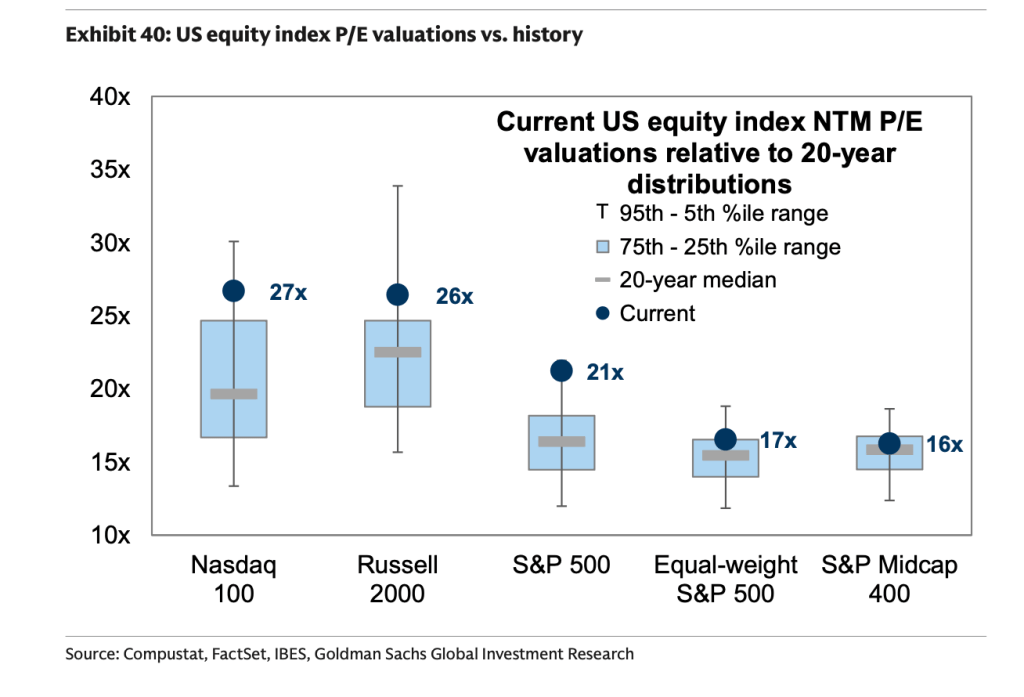
Both banks were careful to hedge, not issuing perma‑bull calls. Deutsche flagged higher inflation and modestly higher long‑term rates and Goldman acknowledged slowing buyback growth as AI capex soars. But seen through Lamont’s frame, they fit a familiar pattern: base cases that lean on sustained double‑digit earnings growth, rich valuations and an AI investment boom that never stumbles. Dimon and Dalio aren’t sounding so sure about this.
‘It’s gung‑ho, folks’: May 27
Speaking on May 27 at Bernstein’s Strategic Decisions Conference—more than a week before Friday’s sell‑off—Dimon delivered a blunt description of what he’s seeing from the banking world’s front row.
“It’s gung‑ho, folks,” he said. “The deals are flowing, bankers are busy, sponsors are spending. The clients aren’t hesitating.” He saw M&A tracking toward the best year in recent memory and equity capital markets activity—IPOs and follow‑ons—being “huge.” In the week that followed, Anthropic confidentially filed for an IPO, Goldman raised its IPO forecast, and SpaceX formally filed to go public.
Then Dimon reached for a word with a loaded history, the same one Lamont used. “There’s a lot of exuberance out there,” he said, echoing the “irrational exuberance” phrase famously coined by former Fed Chair Alan Greenspan in 1996 — a concept he first expressed to Fortune itself all the way back in 1959. It’s not really irrational exuberance to critics, though, it’s bubble brain.
Dimon anchored his feeling in four specific years: 1972, 1986, 2000, and 2007. Each, he noted, was a moment when confidence was high, deal activity robust and the consensus believed the fundamentals justified the optimism—right before the music stopped. The 1973–74 bear market decimated the “Nifty Fifty” blue‑chips; the 1987 crash of “Black Monday” and savings‑and‑loan crisis followed early Reagan exuberance; 2000 marked the peak of dot‑com euphoria; 2007 was the last year before the global financial crisis. Dimon’s unease, he said, is not that business isn’t strong, but that when something “feels good,” trouble often lurks around the corner.
Dimon also flagged the role of fiscal policy, estimating that $10 trillion to $12 trillion in deficit spending over six or seven years had mechanically boosted corporate profits and demand. The risk, he suggested, is that markets are treating this as organic strength rather than a sugar high. “The government borrows money and gives it to people and that money gets spent,” he said. “It also fuels corporate profits. Corporations, it’s just not all automatically, they’re all geniuses all of a sudden.”
Dalio and the specter of 2000
On June 3, the day of Lamont’s note, Dalio told Bloomberg Television that his own proprietary “bubble indicators” tracking sentiment, concentration and valuations showed U.S. equity markets “rising close to—not at—the same level in 2000 and the same level in 1929.”
Dalio stressed that a bubble forming and a bubble bursting are different events. The “pricking,” he argued, usually comes when investors have to convert paper wealth into money—selling assets to pay debts or taxes. “You cannot spend wealth,” he said. “You have to sell wealth to get money, because you can only spend money.”
Goldman Sachs has an in-house skeptic who has been airing the AI bear case for years. James Covello, the bank’s global head of global equity research, questioned the trajectory of markets on the bank’s Exchanges podcast on Tuesday, June 2. The core question hasn’t changed, he said.
“At some point, you’ve got to make money,” he said. “You make investments in a business so that you can generate returns and make money. And we’ve gotten further away from that over the last couple years instead of closer to it.”
Covello recalled that in a 2024 research note, he had estimated it would take 18 months to two years to see whether the torrent of capital flooding into AI infrastructure would generate returns commensurate with the spending. We’ve blown past that, he told colleagues Allison Nathan and George Lee, and it still hasn’t happened. (He didn’t directly address the multiple trillion-dollar IPOs in the pipeline.)
George Lee, co‑head of the Goldman Sachs Global Institute, was more optimistic on AI’s long‑term potential and estimated that $7 trillion to $8 trillion will eventually be spent on AI infrastructure globally. Just “disrupting” existing profit pools, he argued, won’t cover that; the math only works if AI creates substantial net new economic activity, but the enterprise ROI data are underwhelming so far. “I really think it all boils down to one thing: do the enterprises make or save money implementing AI?” Covello said. “If they do, this technology is going to fulfill its promise.”
The shadow blog: ‘The Token Bill Cometh Due’
The skeptics are out there, arguing the ROI will simply never come and the 1999 moment is far more apt than most want to admit. “When the bubble pops,” software engineer Benjamin Horne wrote on his Substack on June 3, “Paul Kedrosky, Ed Zitron and Gary Marcus get to take the single most insufferable, gloating, run-it-back-a-thousand-times told-you-so victory lap in the recorded history of being right about something.”
Marcus told Fortune in August 2025 that what he was seeing in markets was “almost tragic” as “crowd psychology” drove markets ever higher. He referenced the famous John Maynard Keynes quote: “The market can stay irrational longer than you can stay solvent,” as well as his own favorite visual metaphor: Looney Tunes’ Wile E. Coyote following Road Runner off the edge of a cliff and hanging in midair, before disappearing offscreen, as gravity pulls him down to earth.
Horne, a self‑described member of the “AI is a bubble” camp, argued that a significant share of the “record revenue” reported by frontier labs like OpenAI and Anthropic exists only because they have been heavily subsidizing tokens—selling compute at steep discounts to build market share. “Strip out the massive token subsidies, make every user and enterprise pay the full cost of the compute they’re torching, and a gigantic chunk of ‘demand’ evaporates the instant it touches reality,” he wrote.
Fortune‘s Jeremy Kahn declared on May 28 that tokenmaxxing was “over” as several prominent companies — Uber, Microsoft and Amazon among them — publicly wrestled with Goodhart’s law, the maxim that a measure ceases to be a good measure when it becomes a target.
“Think about what most people actually use LLMs for,” Horne urged: summarizing articles, searching the web, rewriting emails, planning vacations and finding good food recommendations. Basically none of this needs a frontier model or tokens, he argued. “The ‘average of human knowledge’ is becoming free, and it’s becoming free fastest exactly where 95% of the demand actually lives,” he wrote. “That is a moat problem of apocalyptic proportions and almost nobody is pricing it in properly.”
Friday’s sell‑off doesn’t prove any of these critics right and it doesn’t mean Friday’s losing day is the bubble popping. Greenspan’s “irrational exuberance” speech came three years before the 2000 peak, after all, and as TKer’s Sam Ro often writes, markets tend to go up over the long term. The internet did change the economy and the world eventually, but the dotcom bubble popped in 2000 anyway.
In 1999, there were plenty of sharp down days before the real unwind. The question now is not whether AI is “real”—even the skeptics concede it is—but whether the cash flows and productivity gains arrive in time, and at sufficient scale, to justify the expectations that have been layered on top of it, or if AI evolves into a really great way to rewrite your emails and put your decks together, instead of a civilization-threatening apocalypse. Ironically, that outcome may lead it to threaten a market wipeout — if not apocalypse — itself. Friday’s session was a reminder that when investors are already out over their skis, it doesn’t take a recession to make the slope feel suddenly steeper.
This story was originally featured on Fortune.com


