
 2 months ago
25
2 months ago
25
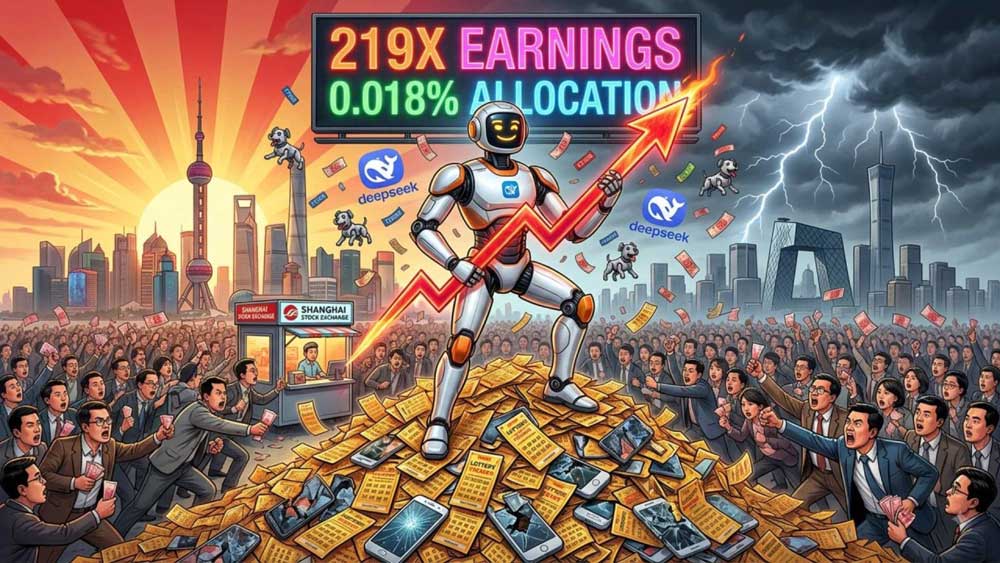
Or: How 9.8 million Chinese decided that a stock trading at 219x earnings is a bargain — and they're right, until someone dumber shows up.
If you've ever thought playing the lottery was a mathematical scam, try subscribing to Unitree Robotics' IPO. On August 10, 2026, on Shanghai's STAR Market, China's first publicly listed pure-play humanoid robot maker opened its books. The result? A retail investor oversubscription of 8,288 times, with an allocation rate of 0.018%. Translation: for every 10,000 people who threw money at this, fewer than 2 walked away with any shares. Your typical national lottery gives you roughly 1 in 300 million odds. This IPO gave you 1.8 in 10,000. You do the math.
And we're not talking pocket change. Total orders hit roughly 8.1 trillion yuan — about $1.2 trillion — all queuing up for a mere $900 million offering. It's as if all of Italy decided to buy an apartment in Milan, but only one was for sale.
The Robot Worth $9 Billion (That Still Can't Make Coffee)
Unitree priced its shares at 150.8 yuan, for a valuation of about 61 billion yuan — roughly $9 billion. Nice, right? Except that figure translates to 219 times 2025 earnings and 36 times sales.
For perspective: Apple trades at around 30x earnings when people are actually buying iPhones. Tesla, at its most delirious, touched similar multiples, but at least it was selling millions of cars. Unitree? It shipped 5,500 humanoid robots in 2025. Yes, that's more than any other manufacturer on Earth. Yes, revenue quadrupled to 1.7 billion yuan. But 219x earnings for a company that generates less revenue than what a mid-tier cruise line loses in a slow summer is, technically speaking, what financiers call "a bit rich."
The gross margin is respectable though — nearly 60%. So either these robots cost almost nothing to build, or they're sold at astronaut prices. Probably both: the average price of Unitree's humanoids crashed from 593,400 yuan in 2023 to 167,600 yuan in 2025. Discount bin stuff, if you're used to Shanghai rent prices.
Why Is Everyone Losing Their Minds? Three Magic Words
First: it's the first. The first pure-play humanoid robot manufacturer to list on mainland China's exchanges. In a market where FOMO is a national sport, being first matters more than the balance sheet. It's the same logic that had people buying JPEGs of bored apes: if there's a "first," there's someone willing to pay more than the first person did.
Second: DeepSeek. Yes, that DeepSeek. The AI company that made Wall Street shiver in January is among the strategic investors in this IPO. If the most talked-about AI firm in China is putting money in, then you must put money in too. That's the logic. Don't ask me if it makes sense — ask the 9.8 million subscribers.
Third: Beijing. The Chinese government has declared advanced robotics a strategic national sector. The IPO was approved by the STAR Market listing committee in 73 days, a record pace. When the Party wants something to happen, it happens fast. And when the Party wants it, capital follows. This isn't investment advice; it's geopolitical observation.
The Founder, the Votes, and the Small American Problem
Wang Xingxing, the founder, is 32 years old. He built his first robot ("XDog") as a grad student, briefly worked at DJI, then founded Unitree at age 26. Today he controls the company through Class A shares that carry 10 votes each. You put in the money; he makes the decisions. Shareholder democracy, Chinese style.
Then there's the small matter that 13.3% of revenue comes from the United States, and Washington has already imposed new restrictions on imported humanoid and quadruped robots. The prospectus warns that U.S. tariffs, government purchase limits, export controls, or loss of existing approvals could "hurt overseas expansion." But hey, who worries about trade wars when there's a robot doing backflips on TikTok?
The Probability Lesson Nobody Wants to Hear
Here's the core: $1.2 trillion in demand for a $900 million offering. This isn't a market; it's a pilgrimage. It isn't investing; it's gambling. The only difference between this and a casino is that at a casino, you at least know exactly how much you're losing.
A 219x earnings valuation says exactly one thing: the market isn't buying Unitree for what it is today, but for what it hopes it will be tomorrow. And tomorrow, according to company plans, means producing 75,000 humanoid robots and 115,000 quadrupeds annually. Ambitious? Yes. Realistic? Maybe. Does it justify $9 billion today? Well, if it did, you wouldn't need 9.8 million people elbowing each other for 0.018% of the shares.
The Moral of the Story
Unitree Robotics is the epitome of everything that makes modern finance both fascinating and terrifying: a real product (unlike many AI startups selling PowerPoints), impressive growth, government backing, a DeepSeek endorsement, and a valuation that would make even a San Francisco venture capitalist blush.
Is it a bubble? Maybe. Is it the future? Maybe. Is it a great story to tell at the bar? Absolutely.
My advice? If you're among the lucky 0.018% who got shares, congratulations. You won a lottery with worse odds than the actual lottery. If you're thinking about buying at the debut?
Good luck. You'll need it.