
 1 month ago
21
1 month ago
21
President Trump was clear in his pitch to voters: In 2024, he pledged to bring back the American Dream. Removing immigrants “taking jobs from American workers and driving down their wages” was a key part of the plan.
A few years later, the effects of this policy are now visible in the labor market. January data from the Census Bureau showed an historic decline in net international migration, down from a peak of 2.7 million people in 2024 to an estimated 321,000 by mid-2026. Brookings puts that figure even lower, saying the U.S. could see negative net migration this year.
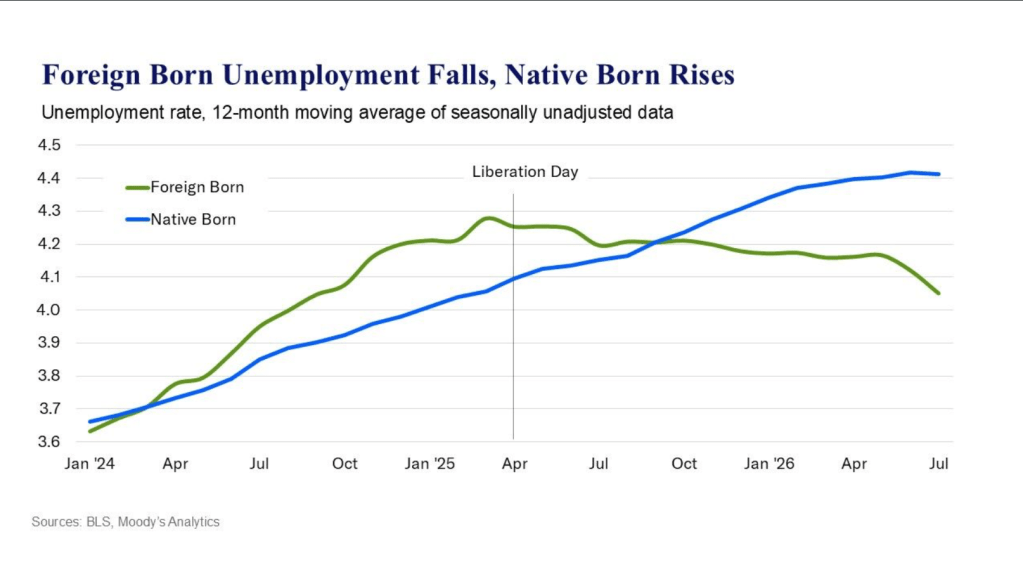
Economists previously told Fortune that this changing pattern has helped stabilize the U.S. unemployment rate as demand has dropped over the past few years, with the rate holding steady at 4.1% in the latest data. But Mark Zandi, chief economist at Moody’s, recently noted foreign-born unemployment fell below native-born unemployment in October 2025, based on analysis of a 12-month moving average of seasonally unadjusted data.
The drop in foreign-born unemployment is relatively easy to explain, Zandi tells Fortune: The immigrant labor force is shrinking because of White House policy, and unemployment for the demographic is relatively lower as a result.
The rise in native-born unemployment is more complex. A major driver is that demand for labor has generally fallen, Zandi tells Fortune—so it stands to reason that if U.S.-born workers now make up a larger share of the labor force, this cohort would be affected more heavily by changes in demand.
But there’s also the issue that the careers and wages immigrant workers have been willing to commit to aren’t viewed in the same way by native workers.
The Bureau of Labor Statistics writes that in 2025, foreign-born workers were more likely than native-born workers to be employed in sectors like construction, trucking, and natural resources, as well as health and personal care. The median weekly earnings of foreign-born, full-time wage and salary workers are also lower—immigrants earn 85.7% of the pay earned by their native-born counterparts, the BLS notes.
President Trump’s theory is being tested: It seems even if native-born Americans face reduced competition for roles, they don’t want the jobs anyway.
“It just goes to show how difficult many of these jobs are,” Zandi said. “Native-born workers would take them, but it would require much, much higher wages … [and that] would make it uneconomic for the businesses to actually produce whatever it is they’re doing.”
“These jobs are typically ones that are very difficult, very arduous jobs that require a lot of physical hardship, and the native-born workers just haven’t done these jobs for quite some time and are in no mood to take them now—certainly not at these wages.”
Societal framing
There’s also a lag on the skills and awareness of the jobs which have been typically occupied by immigrants, Zandi explains: “These jobs have been held by immigrants for years, decades, generations, and native born workers don’t have the predilection or the skills to be able to do these jobs—at least not anytime soon.”
“Over time, that may change, but that’s not the case today. There’s all kinds of impediments to native born people taking these jobs because … it’s not even in their thought process.”
Zandi added: “In many cases it goes beyond the job itself, some of the jobs are … in very remote areas of the country where housing is very different, and other amenities and services just aren’t available. So it goes beyond the job to the infrastructure and support for the people living there. So immigrant workers have been willing to do it, but native born historically have not, and it’s going to take an awful lot to get them to do it.”
The White House insists the plan is working. Spokesman Kush Desai told Fortune: “Unchecked illegal immigration had long depressed wages for American workers. Thanks to President Trump’s commonsense border security and immigration enforcement agenda, real wages for American workers in key sectors, including construction, manufacturing, transportation, and warehousing, are growing by leaps and bounds compared to overall wage growth.”
“The simple reality is that President Trump is delivering.”
Data from the New York Fed somewhat supports that claim. The regional Federal Reserve bank reported in May that public administration and the construction and mining industries have seen wage growth, either because of demand related to the construction of AI data centers or because of D.C. policy, “especially since the construction industry tends to rely on immigrant workers.”
Nevertheless, the report found that most industries have experienced a synchronized decline in wage growth since 2022.
Zandi suspects that in the coming years, immigration policy will be forced to reverse, but the immediate impact of the labor market trade-off will be stagflationary. Prices will rise, he believes, without a corresponding jump in output.
“The supply-side stagflationary shock of tariffs does the same thing,” he added. “The Iran war is also a stagflationary or a supply shock. So you’ve got these three massive, policy-induced supply-side shocks that are reducing growth and lifting inflation, and the only reason why the economy isn’t in complete shambles is because of AI.”
This story was originally featured on Fortune.com