
 3 months ago
35
3 months ago
35
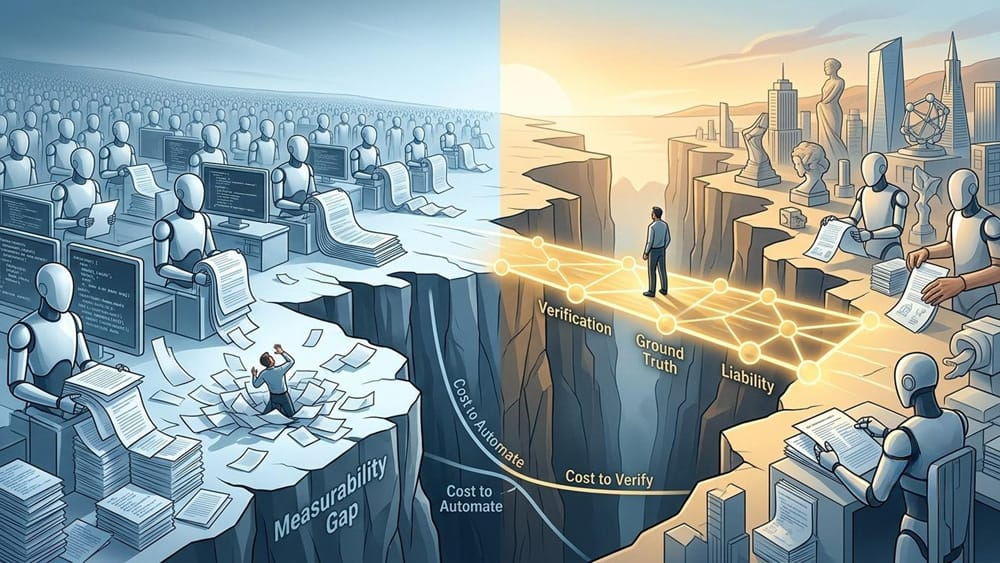
I spent the weekend with "Some Simple Economics of AGI" by Christian Catalini (MIT Sloan), Xiang Hui (Washington University in St. Louis), and Jane Wu (UCLA Anderson) — 113 pages that upend how we think about the economic impact of artificial intelligence.
The conclusion is as revelatory as it is unsettling: we are building a future where we can do everything, but can no longer verify anything.
The Paradox of Decoupled Cognition
For 300,000 years, human cognition was the sole engine of progress on Earth. Today, AI is decoupling intelligence from biology, and its capacity to recombine knowledge — exhaustively mapping every combination within the known landscape — is driving the marginal cost of measurable execution toward zero.
But this isn't "simply" the automation of routine work. Vast swaths of what we once considered creative, analytical, and innovative are at risk — any labor that can be captured by metrics.
Most economic models treat AI as a labor substitute or complement to exogenous human judgment, assuming machine output translates directly into realized value. The authors argue this paradigm is dangerously incomplete.
The Migration of Constraint: When Abundance Creates Scarcity
There's an ancient and underappreciated economic principle: when a scarce resource becomes abundant, the constraint does not vanish — it migrates to its nearest complement.
In an economy where agents act with broad agency, the binding constraint on growth is no longer intelligence. It is human verification bandwidth: the scarce capacity to validate outcomes, audit behavior, and underwrite meaning and responsibility when execution is abundant.
The authors model the transition toward AGI as the collision of two racing cost curves:
- Cost to Automate: In steep exponential decline, driven by compute power and accumulated knowledge
- Cost to Verify: Biologically bottlenecked, bounded by human time and embodied, lived experience
This structural asymmetry widens a Measurability Gap — the chasm between what agents can execute and what humans can afford to verify.
The Implicit Compact of the Economy — and How It Risks Breaking
Economic progress has always rested on an implicit compact: the value claimed was the value produced. The Measurability Gap represents the first force in history capable of systematically breaking that compact — not through crisis events, but through the ordinary economic dynamics of cost minimization.
When an AI agent generates output that appears impeccable, passes every formal validation, yet silently violates unquantified human intent, the economy accumulates invisible systemic risk.
Three forces eroding the "human-in-the-loop" equilibrium:
🔹 The Missing Junior Loop: Traditional apprenticeship pathways are collapsing. Junior profiles are being stripped of the operational grunt work — the very routine activity from which real competence actually emerges. The paradox is clear: human expertise is shrinking precisely in the era when critical oversight becomes an irreplaceable asset.
🔹 The Codifier's Curse: Experts convert their own experience into training data, codifying their own obsolescence. Every time a senior documents their know-how to instruct a model, they are effectively forging their own replacement.
🔹 The Trojan Horse Externality: As capabilities outpace oversight, deploying unverified systems becomes privately rational. But it introduces an externality of misaligned output, invisibly accumulating in the system. Using AI to verify AI doesn't solve the problem — it manufactures false confidence, as correlated blind spots propagate.
The result? A Hollow Economy: geometric explosion of apparent productivity, against a backdrop of progressive loss of human agency. Growth that appears robust, but reveals itself hollow at the core.
But This Outcome Is Not Inevitable
The answer is not a retreat into obsolescence. It is a radical elevation of human purpose.
If we scale verification infrastructure alongside agentic capabilities, the forces that threaten collapse become the catalyst for boundless discovery, experimentation, and execution — powering an Augmented Economy.
The Operational Playbook: For Those Who Want to Act, Not Just Observe
For Individuals:
- Adopt targeted learning to accelerate potential discovery, speed operational excellence, and scale with startup agility.
- In a market where intelligence is now a commodity, human focus must shift to strategic activities: defining objectives, validating results, managing and underwriting risk, or creating value where impact is not quantifiable.
For Companies:
- Investing in continuous monitoring (observability) and the accuracy of real validation data (certified ground truth) is the foundation for triggering exponential value growth and competitive advantage (network effects).
- Identify and attract the best professionals on the market to strengthen underwriting and risk management activities.
- Reorganize around the "AI sandwich" topology: human intent → machine execution → human verification
For Investors:
- Reposition strategically: stop financing now-standardized execution processes to capitalize on the intangible, targeting Deep Tech and long-term R&D.
- Bet on validation infrastructures and Liability-as-a-Service (LaaS) solutions for outsourced responsibility management.
For Policymakers:
- Internalize the cost of externalities through liability allocation systems
- Consider verification and validation processes as an essential public good, accessible and shared
- Ensure that safe, protected scalability is not sacrificed in the name of reckless deployment, thereby promoting the greatest expansion of public goods in decades
The Line That Stayed With Me:
"Scale without verification is not a moat. It is an accumulating debt."The defining economic challenge of the agentic era is not the race to deploy the most autonomous systems. It is the race to secure the foundations of their oversight.
Only by scaling our bandwidth for verification alongside our capacity for execution can we ensure that the intelligence we have summoned preserves the humanity that initiated it.
📄 Catalini, Hui, Wu — Some Simple Economics of AGI (MIT Sloan Research Paper, Feb 2026) 113 pages. Every one of them earned.