
 3 weeks ago
9
3 weeks ago
9
In 2009, the great blogger and cultural critic Mark Fisher picked up on the concept of “capitalist realism,” describing a state of mind where the triumph of this economic organization of life was so complete that it was impossible to imagine an alternative to it. But Fisher, who died in 2017, surely didn’t consider that two capitalisms would compete for headspace.
In one story, the Citrini Research “ghost GDP” thesis, AI is essentially a substitute for labor: codifiable, routine, formalizable work gets automated or compressed, hiring for it dries up, and the firms that move fastest win. In the other, something like Alex Imas’ “relational work” thesis, AI is a complement to labor, raising the value of tacit, contextual, hard-to-codify human judgment, and the firms that treat it as a replacement rather than a force multiplier for people, are quietly mispricing their own workforce.
Gad Levanon, chief economist at the Burning Glass Institute, ran a simple, clarifying experiment this week: ranking every industry’s quits rate against its own 25-year history, rather than against every other industry’s raw rate, splitting the labor market into three tiers that haven’t moved together since 2022—revealing a split between the two capitalisms.
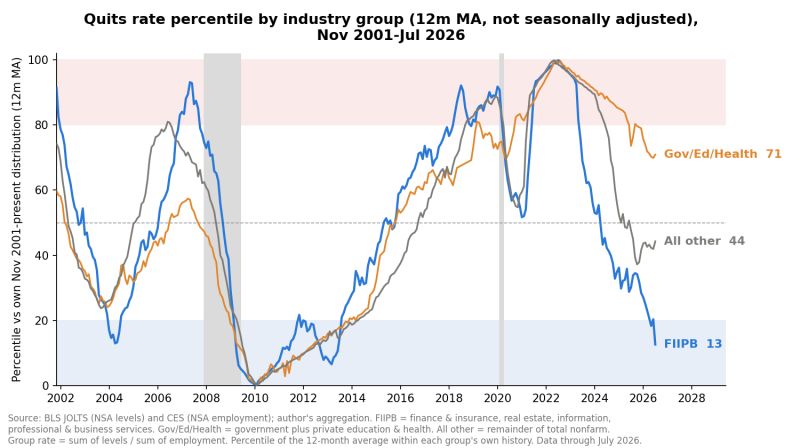
In finance, insurance, information, and professional and business services (FIIPB) the quits rate has fallen to the 13th percentile of its own 25-year range. It sits at 1.8%, down from 2.5% in 2019, a 28% drop, and the lowest reading since 2013. The rest of the private economy is sitting at the 44th percentile, close to its historical norm. Government, education, and health care are at the 71st percentile—effectively unchanged from 2019.
“Job hugging is real, but it’s mostly happening in one part of the economy,” Levanon wrote on LinkedIn. “Only FIIPB has collapsed … because that’s where the jobs stopped.” Levanon found that FIIPB employment peaked in early 2023 and has been falling ever since. “People quit when they have somewhere to go, and in a sector that’s shedding jobs there’s nowhere to go.” Bureau of Labor Statistics data released September 1 shows professional and business services hires fell by 188,000 in July alone, even as job openings ticked up nationally.
When asked what was behind this—was this even the beginning of a reversal of the “financialization” of the American economy over the last four decades—Levanon told Fortune it’s probably not as sweeping as that. More simply, he said it was “a decline in the labor intensity of white-collar work.”
“FIIPB output kept growing; the labor needed to produce it didn’t. Technology, and expectations about what it will soon do, suppressed hiring in codifiable work.” The beginning of this was a “post-ZIRP correction,” he said, a shorthand for zero-interest rate policy, or low interest rates set by the Federal Reserve, but that doesn’t explain a gap that’s “still widening in year four.”
A new working paper out of Stanford’s Digital Economy Lab supplies another missing variable: age. Economists Erik Brynjolfsson, Bharat Chandar, and Ruyu Chen, using high-frequency ADP payroll data covering millions of U.S. workers through June, found no evidence of broad, economywide job displacement, but did find that employment of workers 22 to 25 in AI-exposed occupations now sits 19% below where it would be had it kept pace with their less-exposed peers. Experienced workers in the same occupations show no comparable gap. The divergence isn’t showing up as layoffs—it’s showing up as an absence of hiring.
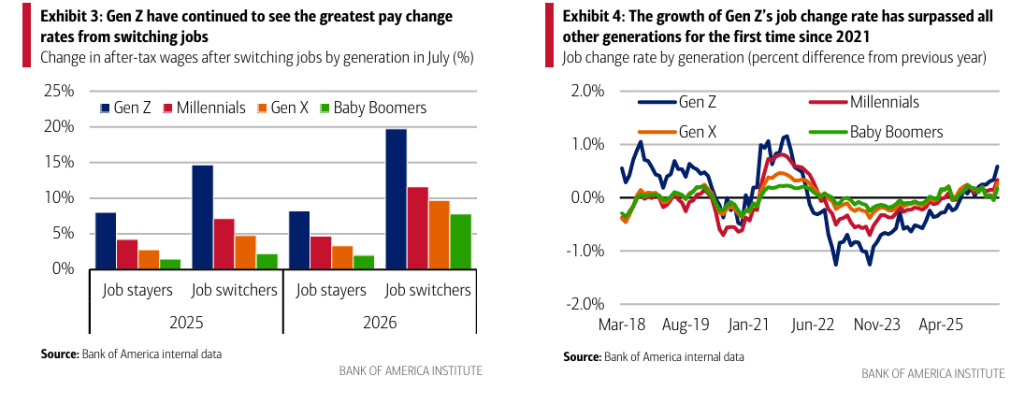
There’s a matching wrinkle in a Bank of America Institute report published September 9: Gen Z’s rate of switching jobs has overtaken every other generation for the first time since 2021, even as broader hiring slows, and Gen Z is getting the largest pay bump of any generation when it does switch. Read next to Stanford’s finding, that looks like young workers being pushed out of the queue for AI-exposed roles and scrambling laterally into whatever is left, faster than anyone else has to.
Both Levanon and the Stanford team are finding the decline concentrated in occupations where AI usage substitutes for human tasks, while occupations where AI complements workers show flat or rising employment, especially for experienced workers. These are the two capitalisms: substitutable work contracting, complementary work holding or rising, in the same economy, in the same months.
Tyler Cowen has been drawing this distinction for months on his blog, Marginal Revolution, parsing the difference between raw “intelligence” that can be automated, on the one hand, and tacit, contextual expertise, or “Polanyi knowledge,” after the Hungarian-British polymath Michael Polanyi. Stanford’s payroll data finds the substitutable work is disappearing specifically for the workers with the least experience to fall back on—the ones who haven’t yet accumulated the tacit knowledge Cowen’s model says should protect them.
Increasing research is dedicated to the pipeline problem: where does the next generation’s tacit knowledge come from, if the apprenticeship rungs are the first casualties of the proxy war being fought over them? The increasing bans on AI in high schools are part of this equation, as is a recent working paper by “China shock” economist David Autor and colleagues. A three-month randomized control trial of 133 practicing patent lawyers produced, over the long run, advantages “concentrated entirely among senior lawyers,” with junior lawyers showing no average gain. “The largest gains from AI thus accrued to the lawyers who retained the least. Foundational expertise may be a prerequisite for extracting durable skill from AI-assisted practice,” the authors wrote.
The irony is that FIIPB is disproportionately the sector that produces commentary about its own contraction, whether through sell-side research from an investment bank or financial news articles like this one. The people narrating the emergency are closer to its zip code than the rest of the country. The media sector is in something like a moral panic over AI, sometimes about the ethics of AI writing, other times about AI doomsday scenarios, but it’s also got considerable skin in the game. As Semafor’s Reed Albergotti noted, AI safety escaping containment makes for “an incredibly fun story.”
Cowen has been reflective on the issue. Responding this month to mathematicians—UCLA’s “Mozart of Math” Terry Tao among them—who warned that the latest AI breakthroughs are encroaching on their field, he invoked Claude Frédéric Bastiat’s distinction between the seen and the unseen: the visible cost to his own status as an economist, he wrote, is real — “not altogether pleasant for me personally, given how much personal status I have wrapped up in particular modes of economic thought” — but the unseen future gains to the field from AI will likely be “enormous, even if current practitioners cannot foresee most of those benefits today.” He went further than almost anyone else writing about this professionally: “I realize AIs someday will end up as better column and blog writers than I am.”
Given the quits data, does Cowen see something more self-interested in the media’s AI-writing backlash than his own admissions might suggest? His answer resisted the clean split. “I think the backlash is both sincere and self-interested, the two motives are working together,” he told Fortune. After all, he added, many “corporate protectionists” actually think tariffs are a good thing and not “cynical profit-seeking,” but they happen to be wrong.
“People just do not want the world to change so much.”
For this story, Fortune journalists used generative AI as a research tool. An editor verified the accuracy of the information before publishing.
This story was originally featured on Fortune.com