

Love it or hate it, The Odyssey (2026) has a lot of people thinking about Ancient Greece. The legendary Trojan War is said to have occurred around the twelfth or thirteenth century B.C., during the time of the Mycenaean civilization.
Fast-forward hundreds of years and we find ourselves in the era known today as that of Classical Greece. Here we meet Telesilla, a poet and a fighter who defended the Peloponnesian city of Argos in 494 B.C.
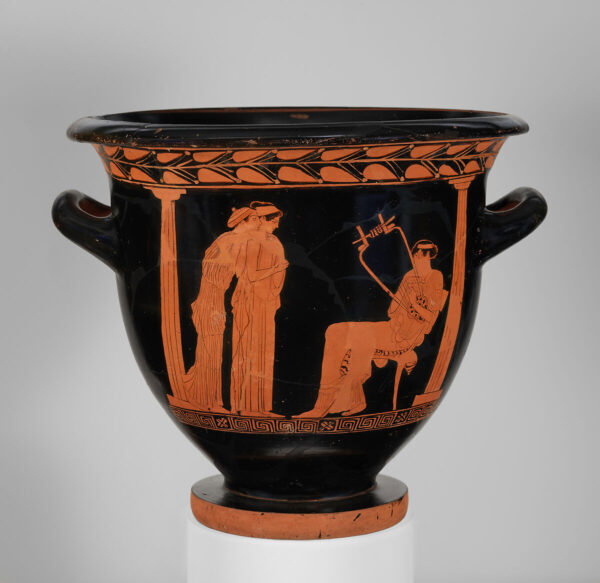 Terracotta bell-krater (bowl for mixing wine and water) Attributed to the Danaë Painter, ca. 460 BCE Metmuseum.org
We don’t know much about Telesilla, and as is so very often the case where Kickass Women are concerned, not all historians believe her to have been real. Only a few sentences of her poetry remain, but many Greek historians and scholars mention both her role as a poet and as a defender of the city.
She was said to have been famous as a poet, and the grammarian Hephaestion named a poetic meter after her. Plutarch claims that she became a poet after the Gods restored her health:
Of all the deeds performed by women for the community none is more famous than the struggle against Cleomenes for Argos (494 B.C.), which the women carried out at the instigation of Telesilla the poet. She, as they say, was the daughter of a famous house, but sickly in body, and so she sent to the god to ask about health; and when an oracle was given her to cultivate the Muses, she followed the god’s advice, and by devoting herself to poetry and music she was quickly relieved of her trouble, and was greatly admired by the women for her poetic art.
So how did the poetess save the city? According to Plutarch, here’s what happened:
But when Cleomenes (I), king of the Spartans, having slain many Argives (but not by any means seven thousand seven hundred and seventy seven [cf. Herodotus, VII.148] as some fabulous narrative have it), proceeded against the city, an impulsive daring, divinely inspired, came to the younger women to try, for their country’s sake, to hold off the enemy. Under the lead of Telesilla, they took up arms, and, taking their stand by the battlements, manned the walls all round, so that the enemy were amazed. The result was that they repulsed Cleomenes with great loss, and the other king, Demaratus, who managed to get inside, as Socrates [FHG IV, p. 497] says, and gained possession of the Pamphyliacum, they drove out. In this way the city was saved. The women who fell in the battle they buried close by the Argive Road, and to the survivors they granted the privilege of erecting a statue of Ares as a memorial of their surpassing valor.
We may not know many details about this woman, but the story of Telesilla continues to inspire travellers, authors, and artists. The poet H.D. (Hilda Doolittle) wrote a poem titled ‘Telesilla’ and artist Judy Chicago included her in the Heritage Floor section of her famous work “The Dinner Party.”
Sources:


