
 4 months ago
19
4 months ago
19
President Donald Trump’s summit with Chinese counterpart Xi Jinping ended last week without a major breakthrough, but still achieved Beijing’s goal of putting itself on equal footing with the U.S.
Meanwhile, China’s industrial might continues to drive export dominance, its AI is nearly on par with the top models, and its military is increasingly advanced.
With the U.S. bogged down in Iran, alliances fracturing, and debt soaring, the narrative on America has pointed in the opposite direction, namely a superpower in decline.
“But in at least one field — financial competition — the opposite is true. China is stagnating, allowing America to dominate by default,” Ruchir Sharma, chair of Rockefeller International, pointed out in a Financial Times op-ed.
The history of the world’s previous empires shows that increasing economic clout typically leads to a currency taking a greater share of global reserves, he noted.
But China’s yuan, or renminbi, claims just 2% of central bank assets around the world, even as the Chinese economy accounts for 17% of global GDP. Similarly, China commands 15% of global trade, while the yuan is used in only 2% of invoices.
By contrast, the dollar accounts for about 58% of global reserves, though that share is slipping, and 54% of trade invoices. Plus, nearly 90% of over-the-counter foreign exchange transactions are in dollars.
Sharma estimated that the world’s second largest economy is running 30 to 40 years behind the historical trajectory of superpowers. This lag is also notable given how much global finance has exploded, with the value of financial assets quadrupling over the last five decades.
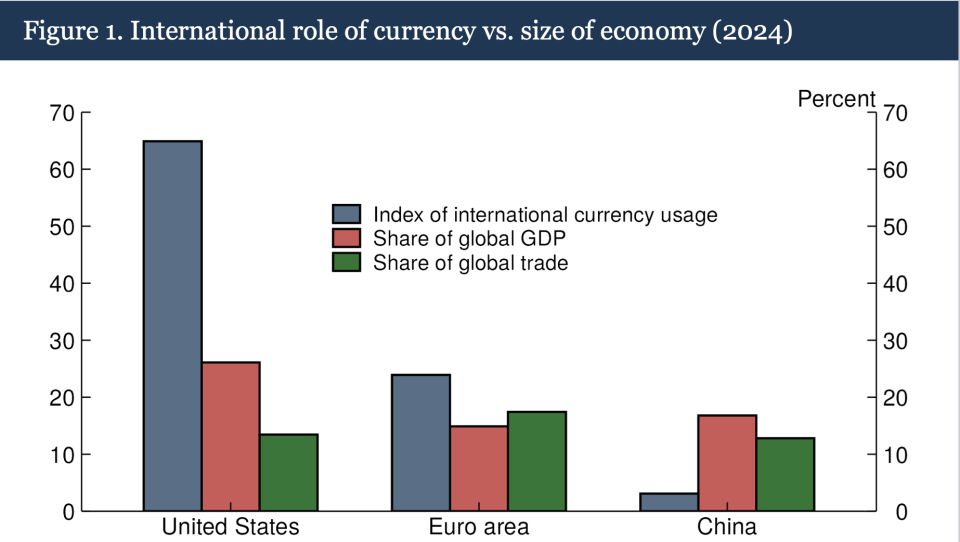
The “exorbitant privilege” of dollar dominance has long been known, allowing the U.S. to borrow more cheaply than its profligate finances would otherwise allow. The U.S. has also leaned heavily on the dollar to impose financial sanctions—a weapon the yuan can’t provide.
“China will remain an incomplete superpower until it can match this financial firepower,” Sharma wrote. “For decades, it has kept its financial system more tightly sealed than any other major nation.”
As a result, foreign investors own less than 5% of the stocks and bonds in China, while capital controls have largely bottled up a massive surge in domestic money supply, he added, describing Chinese markets as a “local prison.”
Beijing is afraid capital will flee the country if restrictions are relaxed, but investors won’t see China as safe until the yuan is traded more freely, Sharma said.
To be sure, China is trying to make the yuan a more international currency. It’s being used in the oil trade more often, and the Iran war has led to speculation that the “petrodollar” could give way to the “petroyuan.”
In addition, use of the yuan among global central banks is up lately. By the end of March, the People’s Bank of China had provided $16.4 billion via foreign-exchange swap lines, the most in two years and the steepest quarterly increase in three years.
Signaling how seriously the U.S. views currency swaps, Treasury Secretary Scott Bessent recently suggested swap lines can help reinforce the dollar’s dominance and reserve status.
Elsewhere, the yuan also advanced in world rankings by one rung to become the fifth most active currency in global payments, according to the SWIFT financial platform.
Still, Sharma thinks China must loosen up more, adding that less strict controls can actually encourage capital inflows rather than an exodus.
“Without a bolder opening, China will never challenge America’s financial dominance and fully realize its superpower ambition,” he said.
This story was originally featured on Fortune.com


