
 1 month ago
11
1 month ago
11
Good morning. CFOs can’t control the economy but they increasingly believe they can control the outcome for their own companies.
That tension—what Deloitte calls a “paradox of promise versus pessimism”—is a defining theme in the firm’s North American Q2 2026 CFO Signals survey, Ed Hardy, U.S. financial services leader at Deloitte, told me.
About a third (33%) of respondents said the economy in North America is bad, compared to only 5% who felt this way in the first quarter. Meanwhile, 90% said they’re significantly or somewhat more optimistic about the future financial prospects of their company. The findings are based on a survey of 200 CFOs from across the U.S., Canada, and Mexico, at companies with at least $1 billion in revenue.
“The macroeconomic outlook has dipped for two consecutive quarters,” Hardy said. “But at the same time, CFOs’ confidence in their own ability to execute strategy and navigate challenges is as strong as it’s been in several quarters.”
The divergence reflects a deeper shift in how finance chiefs are operating. “They’ve built the muscle,” Hardy said.
That is translating into action. Despite concerns about market valuations, 59% of CFOs think now is a good time to take calculated risks (up from 48% last quarter), including accessing debt markets and raising capital. Many believe their companies offer a “unique value signature,” Hardy noted, even in a choppy environment.
 Courtesy of Deloitte
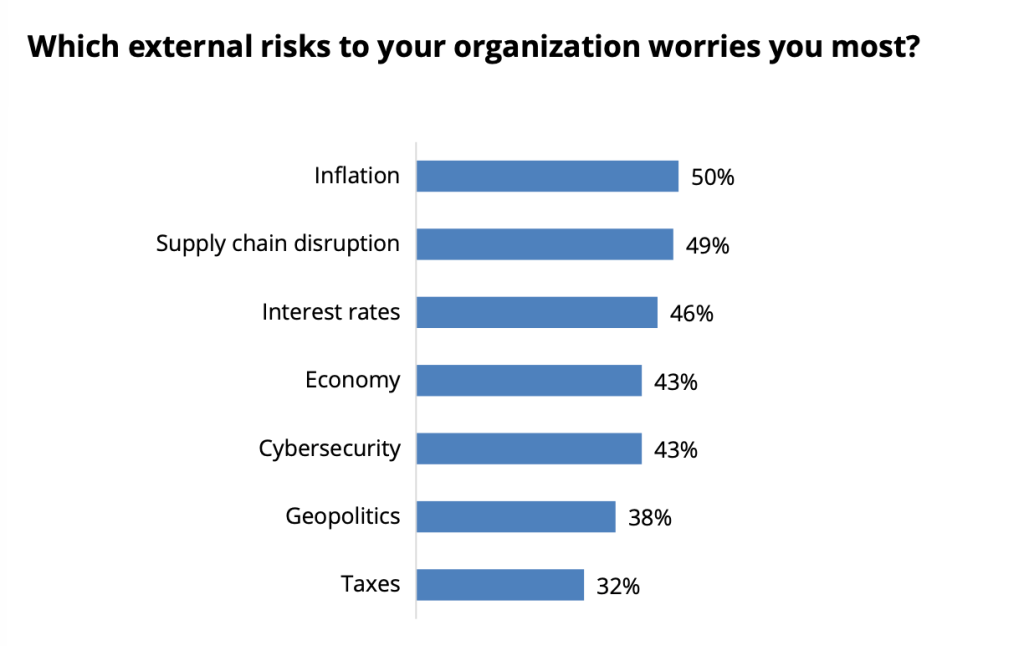
Still, external risks remain front and center. Inflation and broader economic conditions continue to rank among the top concerns, with roughly half of CFOs citing inflation as a key issue to monitor in the months ahead. While the Federal Reserve’s steady rate posture may be supporting some risk-taking, it has not eliminated underlying unease.
At the same time, the role of technology—particularly AI—is more complex than a straightforward confidence booster. Companies are moving quickly to deploy and scale AI, but questions around return on investment, cost management, and governance persist, Hardy said. Finance leaders are also grappling with how to measure value beyond traditional cost savings, as AI opens the door to new capabilities rather than just efficiencies.
 Courtesy of Deloitte
Perhaps the most pressing challenge tied to that shift is talent. In the survey, talent ranked as the top risk factor, cited by 51% of CFOs—higher than any other internal or external concern. The issue spans hiring, retention, and, increasingly, upskilling.
Finance functions are being forced to rethink their workforce mix. Alongside traditional accounting expertise, companies are beginning to integrate new roles such as prompt engineers and AI specialists. But the need for experienced finance professionals remains critical, particularly as “humans in the loop” are responsible for validating outputs and managing risk.
“It’s not just about adding new skills,” Hardy said. “It’s about rethinking how you attract, retain, and incentivize a very different mix of talent.”
Taken together, the findings suggest CFOs are entering a new phase—one defined less by reactive crisis management and more by calibrated confidence.
Have a good weekend.
Sheryl Estrada
[email protected]
This story was originally featured on Fortune.com


