 1 hour ago
2
The Apple iPhone Duo isn't the first foldable. It’s not even the second foldable. It’s maybe the fourth, the fifth, or the sixth following in the footsteps of fantastic flexible phones like the Samsung Galaxy Z Fold 8 Ultra, the Samsung Galaxy Z Fold 8, Motorola’s Razr Fold, and so many other really strong, solid, and sometimes excellent foldables.
But that doesn’t make it any less special. To understand Apple’s iPhone Duo, you need to compare it to its nearest competitor, the one we saw just months earlier from Samsung: the passport-sized Samsung Galaxy Z Fold 8.
There are a lot of similarities. Let’s start with the screens. Both have 7.6-inch inside, or main, screens. Those are the foldable ones. Apple’s is a Super Retina XDR OLED, and the Samsung Galaxy Z Fold 8 is a dynamic OLED.
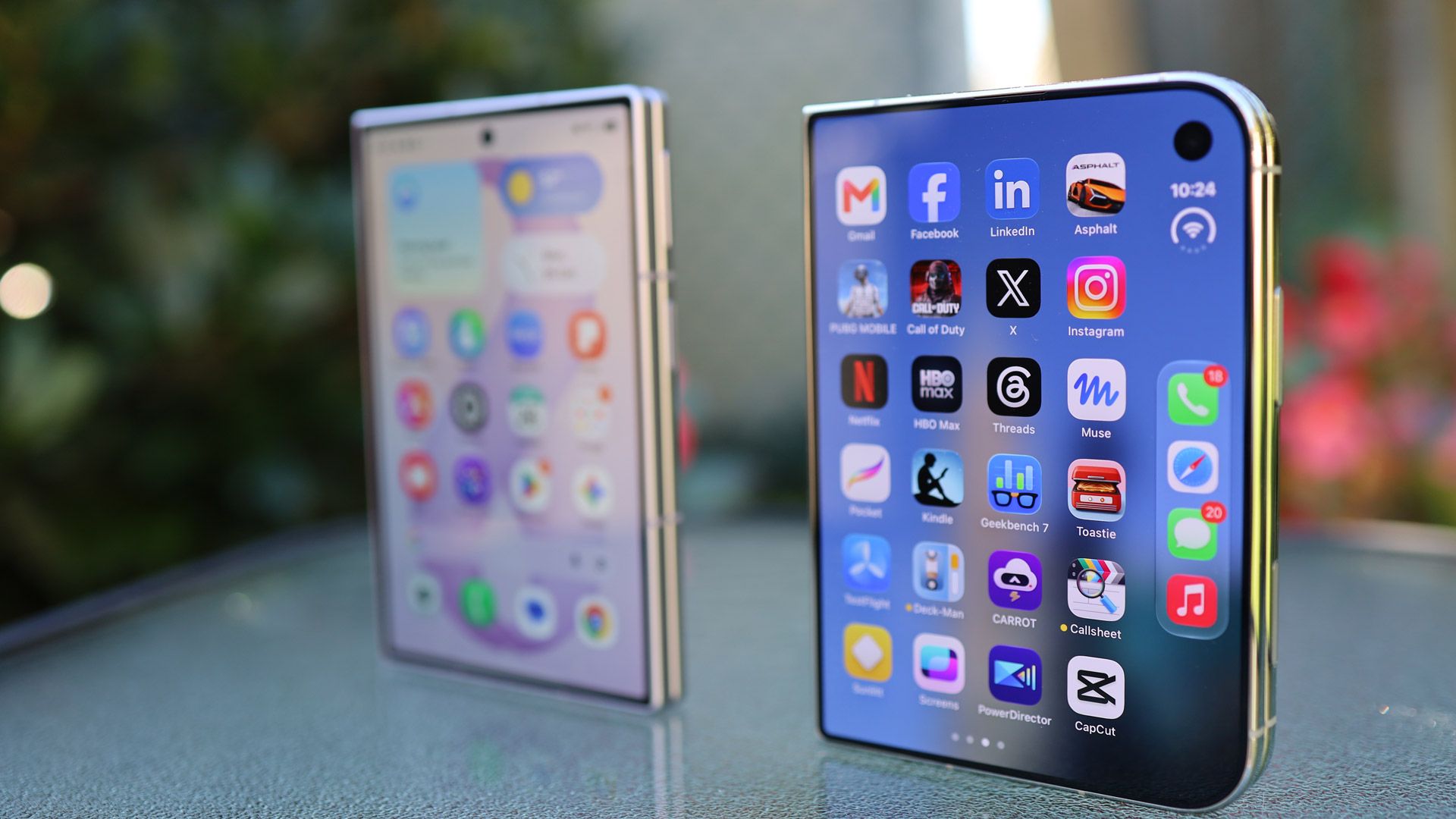
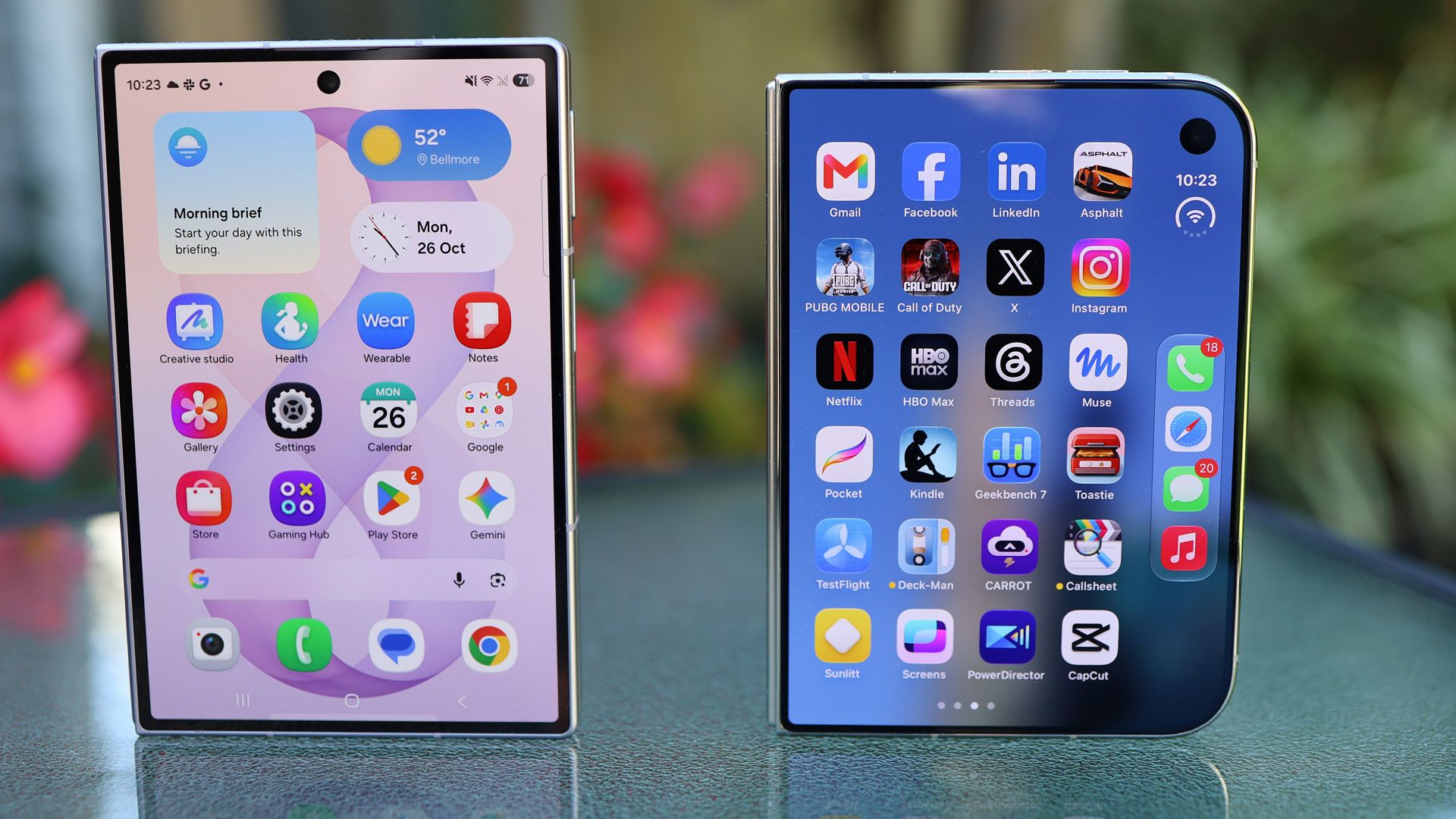
The cover screens are also quite similar. On the Apple iPhone duo, we have a 5.4-inch Super Retina XDR display, and on the Samsung Galaxy Z Fold 8, a 5.5-inch AMOLED.
At a glance, they share that sort of nearly passport-sized shape, although Samsung went for more symmetry, giving its foldable pretty much square corners, while Apple went for a slightly unusual asymmetrical design on its 5.4-inch cover display, which is flat on one side with the hinge and curved on the other (and something we've seen before with Google's Pixel Pro Fold line).
There are a lot of contrasts like this, and I think one of the things that people have tried to do is get me to “admit" that Samsung is better, maybe simply because it’s first, but also because there are areas in which the Samsung Galaxy Z Fold 8 is obviously better than the iPhone Duo. There are also places where the iPhone Duo outshines the Z Fold 8.
Let’s dig into some of the key differences and why, ultimately, it may not add up to a conclusive win for either side.
Design and Displays
From a build-materials standpoint, these are both excellent devices. Apple starts with titanium, polishes it to a fingerprint-attracting shine, and Samsung opts for a pleasing brushed aluminum frame, though there is some titanium underneath the screen.
They both have some really strong glass covers and backs: Apple has the Ceramic Shield 2 on the front and back, and Samsung has Corning Gorilla Glass Victus 2. They're both durable materials. Admittedly, I have had the Z Fold 8 for a little bit longer, and it has a couple of noticeable scratches on the cover screen. I honestly have no idea how they got there.
 Lance Ulanoff / Future
 Lance Ulanoff / Future
On the flexible displays
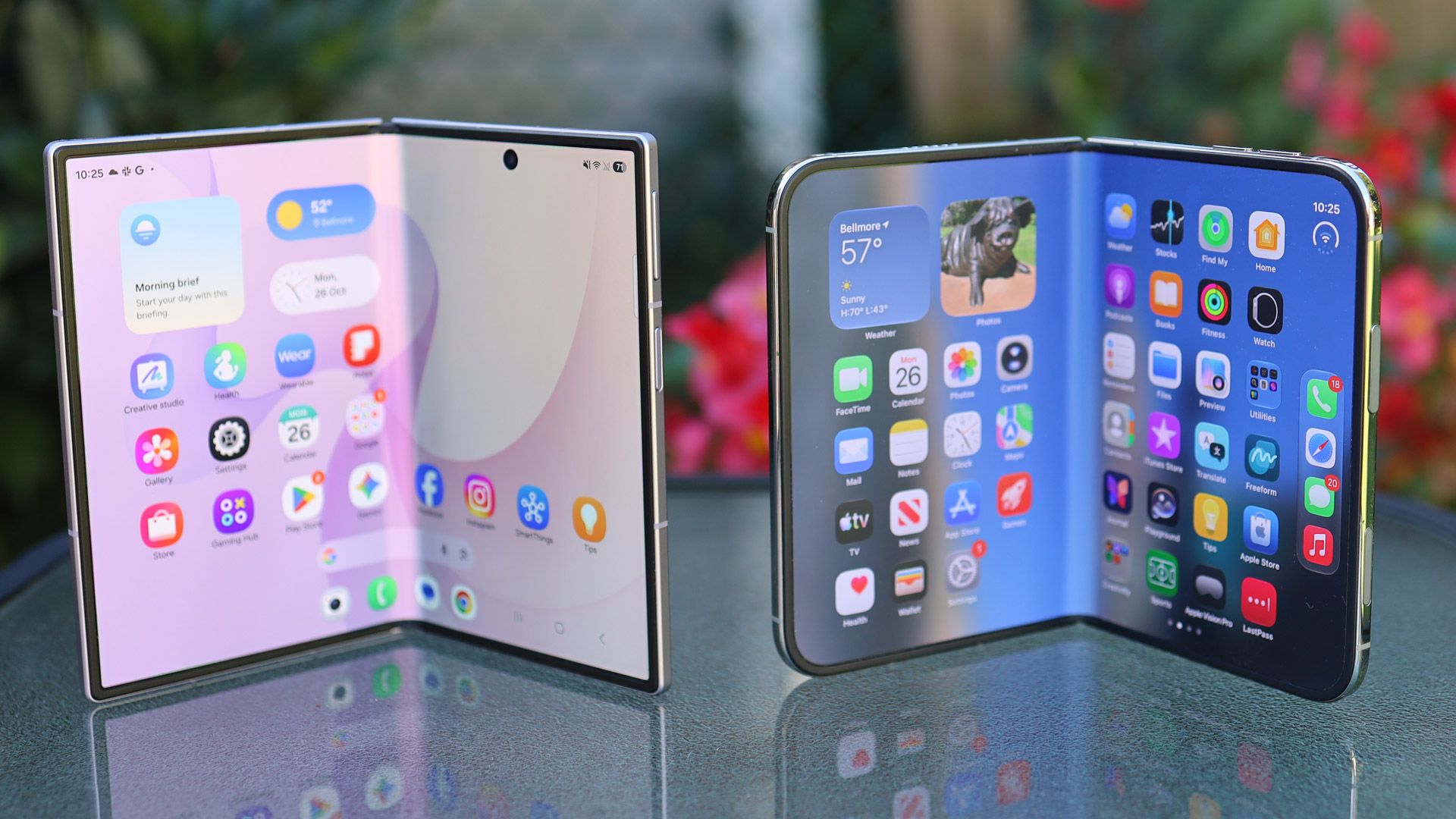
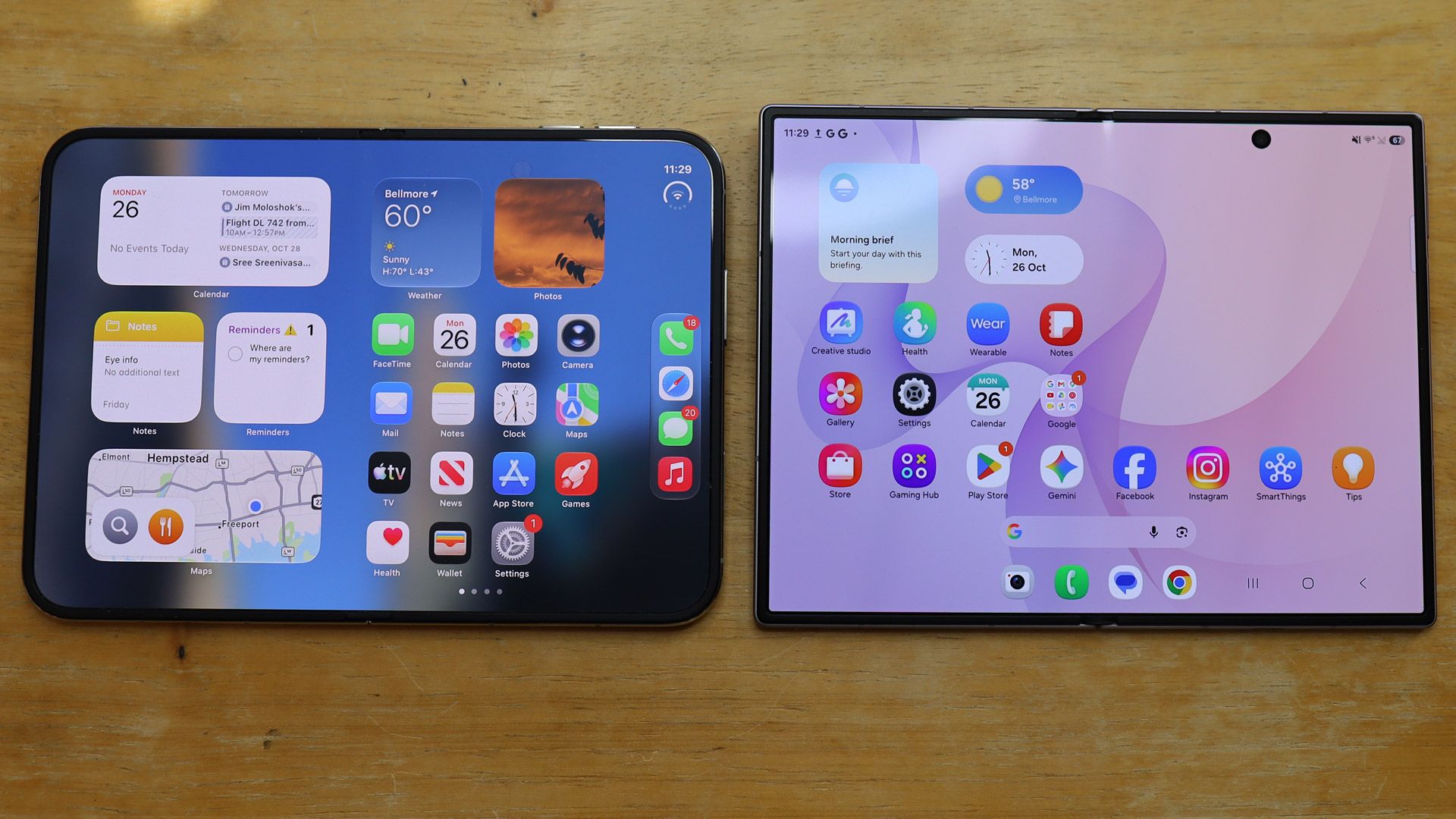
Switching to the all-important flexible inner displays, both are 7.6 inches, so it’s kind of a wash on screen real estate. They both have roughly the same bezel: it's quite thin on the Z Fold 8, and maybe a tiny bit thinner on the iPhone Duo.
One device has squared corners, and one has curved corners. Both support 3000 nits of brightness, but again, the iPhone Duo's inner display has slightly higher resolution. It’s 1878 x 2670, while the Samsung Galaxy Z Fold 8 has 1848 x 2448. Again, that is a relatively small difference, but I think that you notice just a tiny bit more sharpness on the Duo.
Ultimately, that minor resolution disparity isn't what really matters on the inner screen. Let’s look at one of the biggest differences, and a place where the iPhone Duo stands significantly above the Galaxy Z Fold 8.
 Lance Ulanoff / Future
 Lance Ulanoff / Future
 Lance Ulanoff / Future
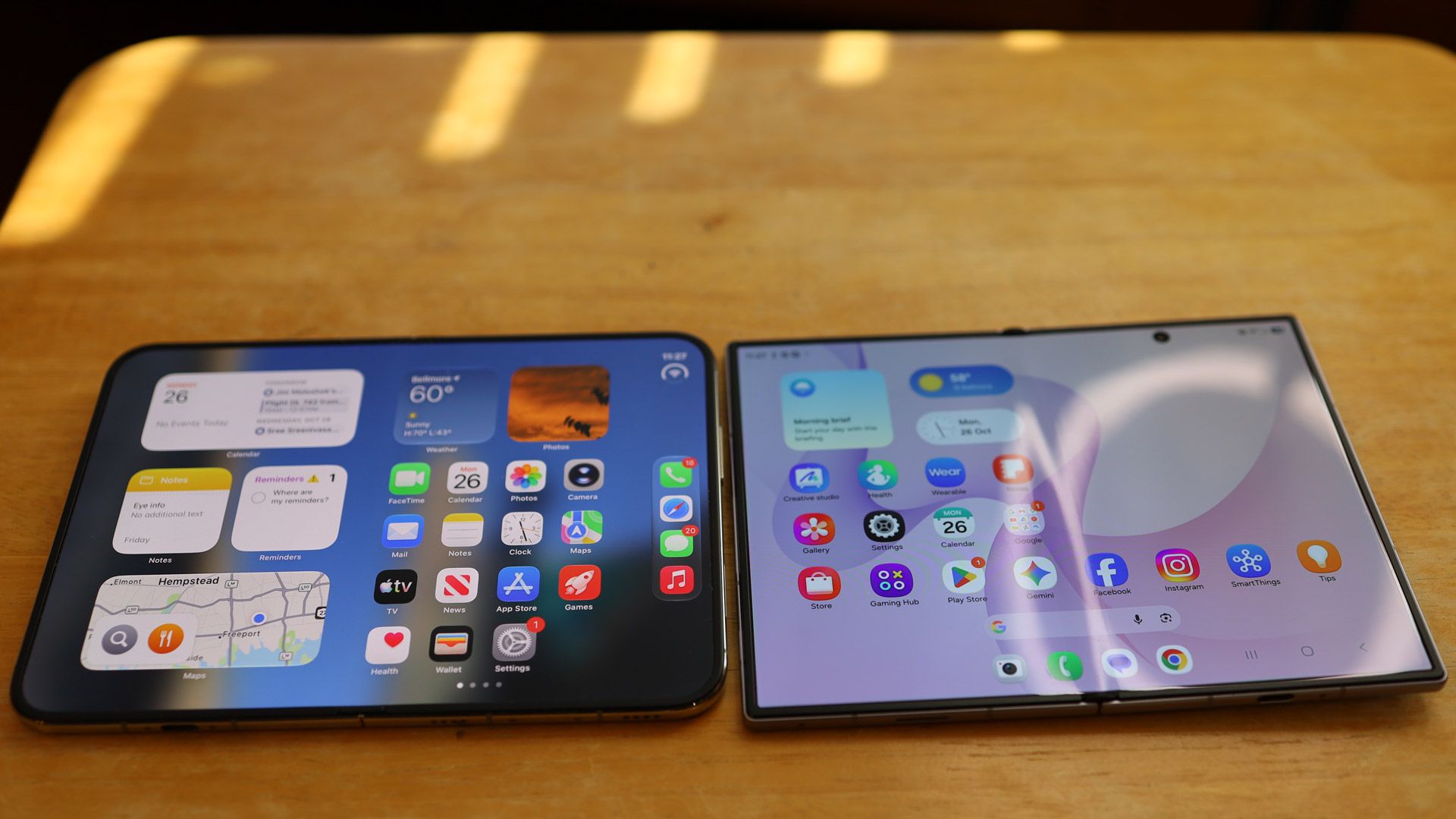
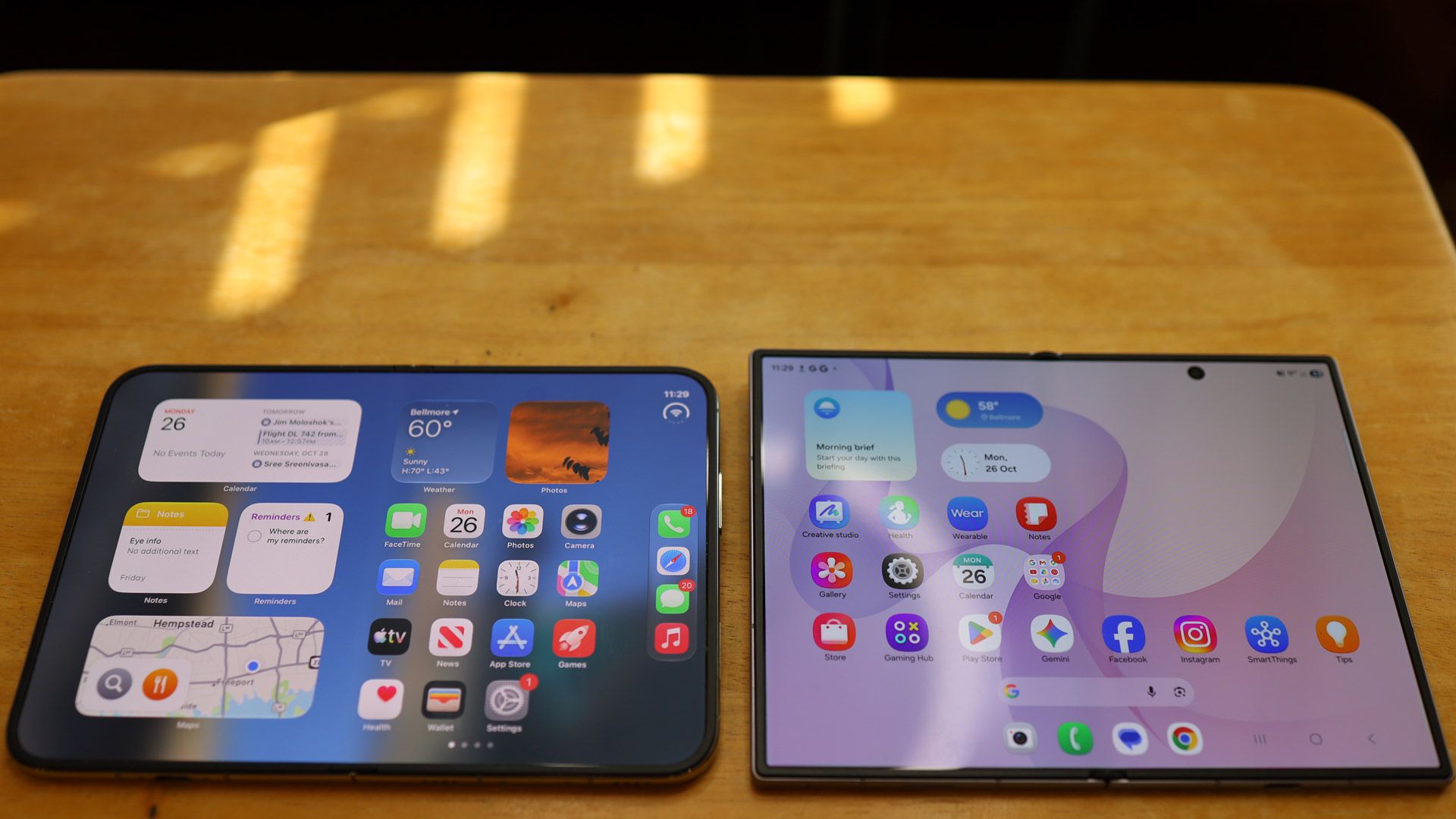
If you’re lucky enough to have the two devices side by side, just shine a light on them, and you will see a difference. Samsung Galaxy Z Fold 8’s flexible display is really lovely, and it is pretty hard to see the crease, except when you shine a light on it; then you can really notice this sort of little half-inch-wide, wavy area that runs vertically on the display.
On the iPhone Duo, it is much harder to see the same thing, thanks to the nano texture covering, a really smart bit of material design on Apple’s part. To be clear, Apple didn’t get rid of the crease entirely.
You can feel it if you put your finger in the right place, but it is difficult, especially when you’re using the screen and looking directly at it in any light, to see the crease because the nano texture disperses the light. It’s just such a smart way to handle this, and it makes for a better experience when you’re using the inner screen.
It all hinges on this
Underneath that visible or invisible crease is the hinge. Samsung has spent nearly a decade perfecting this technology, building ever thinner, lighter, and smaller devices with less noticeable creases and hinges, and the Samsung Galaxy Z Fold 8 is an excellent example of that effort. The hinge sits neatly against the back, and when you open it, you can barely notice the mechanics.
iPhone Duo vs Galaxy Z Fold 8
Hinge mechanism closeup of the two phones
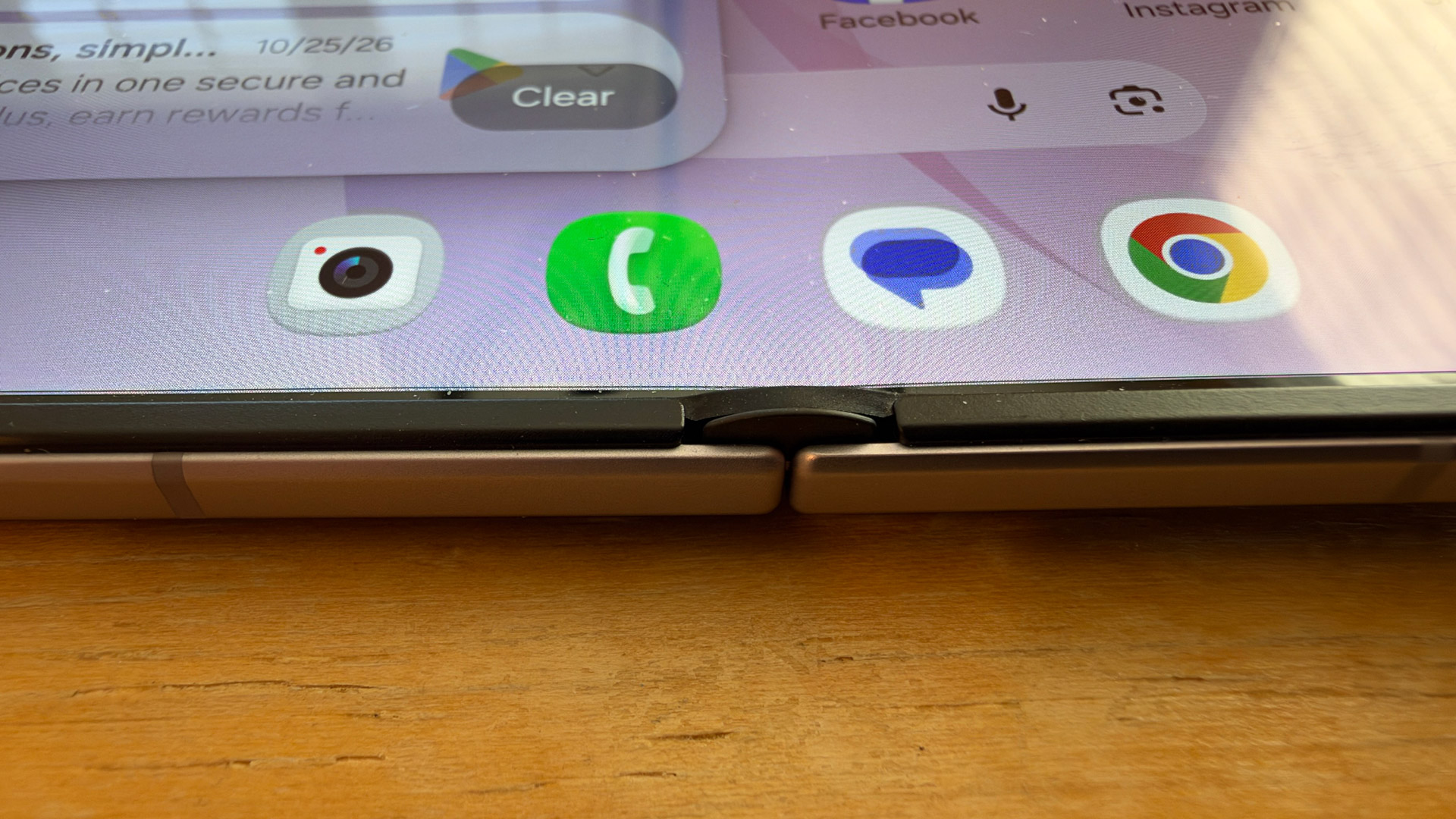
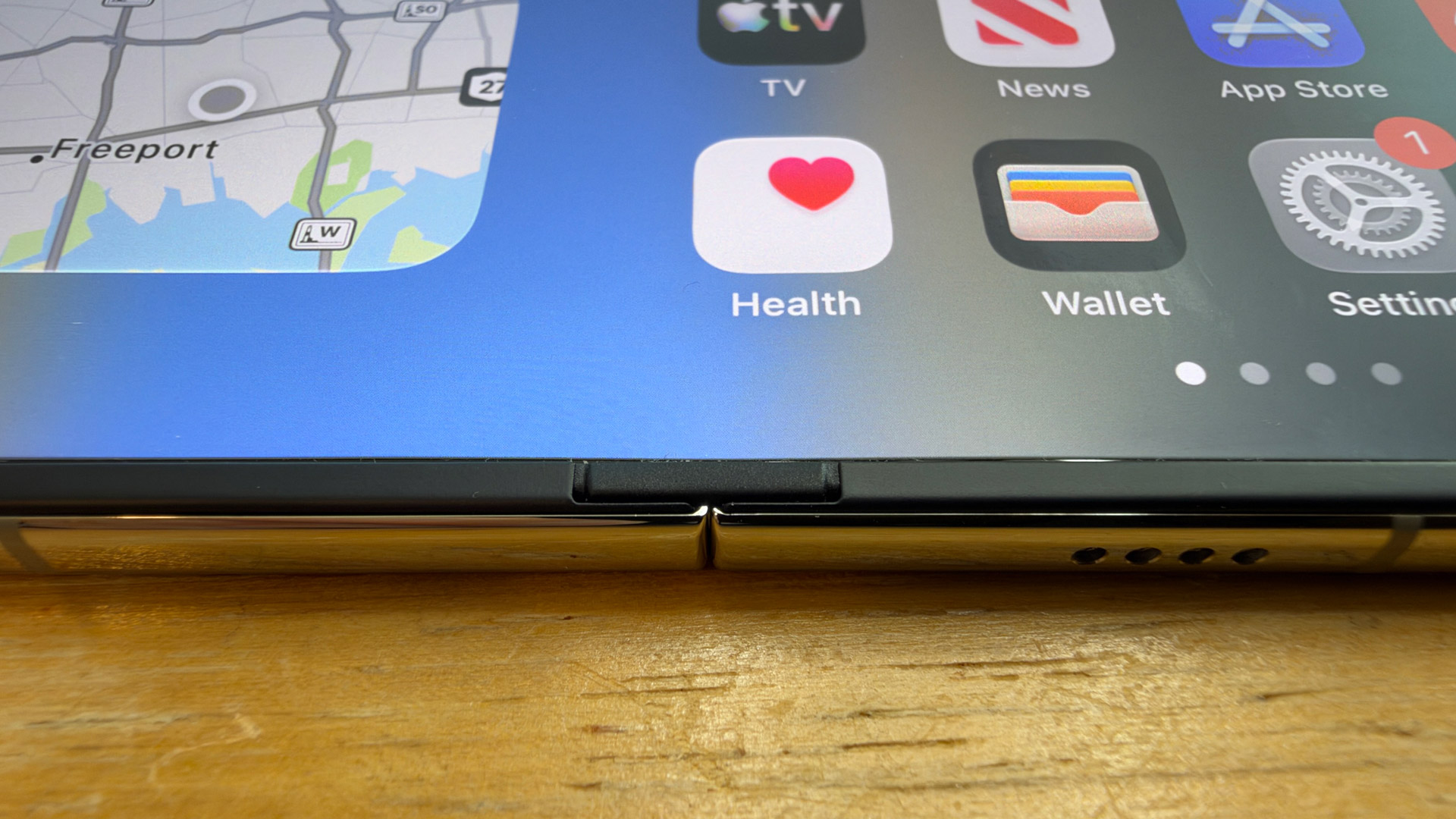


With the iPhone Duo, however, Apple clearly looked at the competition and said, "How can we go a step further?"
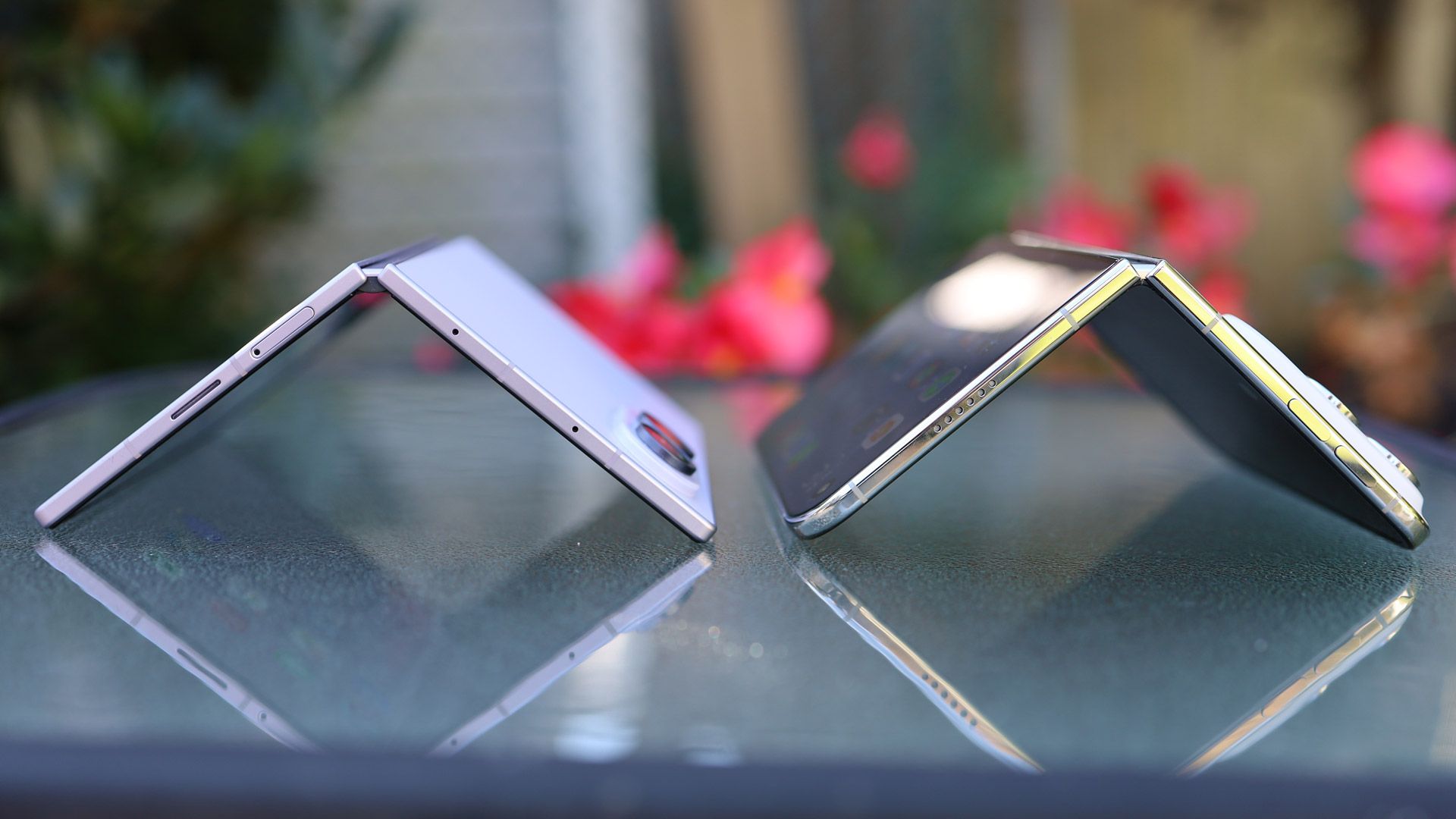
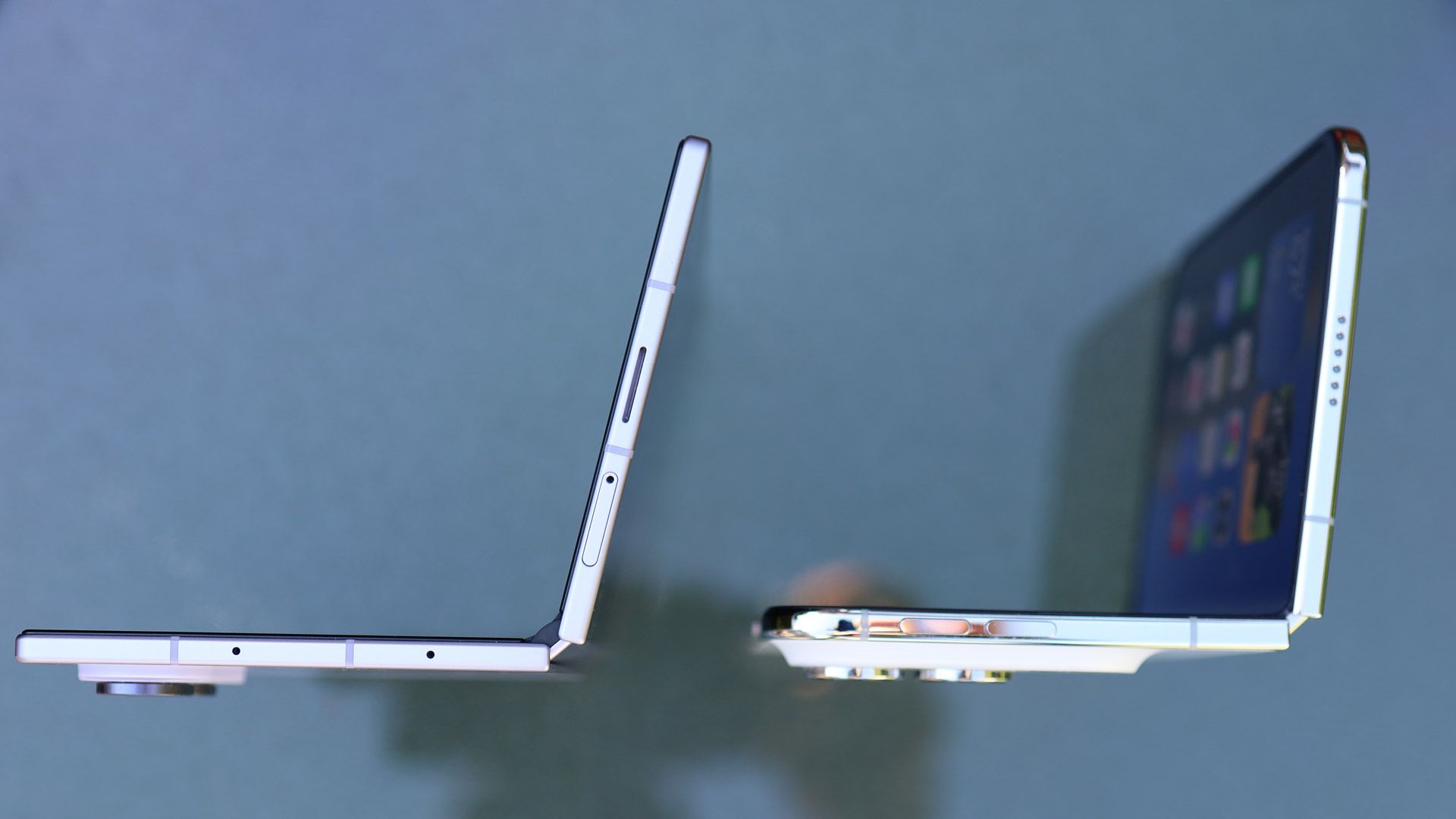
When you unfold a Samsung Galaxy Z Fold 8, it doesn’t fold completely flat at first. You can torque it just a tiny bit, and then it lies basically flat. With the iPhone Duo, you open it completely flat — full stop.
 Lance Ulanoff / Future
 Lance Ulanoff / Future
 Lance Ulanoff / Future
Looking at the hinge areas and the mechanics at the top and the bottom of the Z Fold 8, there’s a little bump for each hinge part. On the iPhone Duo, those hinge areas are flat. The hinges are almost invisible, and that’s not just an aesthetics thing. This foldable is better sealed than the competition.
The iPhone Duo is rated IP68, while the Samsung Galaxy Z Fold 8 is rated IP48. This means that you could drop your iPhone Duo into the water, and it could survive. It also has dust resistance, though I wouldn't assume that means sand resistance.
As for the Samsung Galaxy Z Fold 8, it stops short of that. I think it could handle maybe a little splash, but it’s not something you drop in water, and it’s definitely not something you want to get too much dust in. So that’s a clear, distinctive advantage the Duo has over the Samsung Galaxy Z Fold 8.
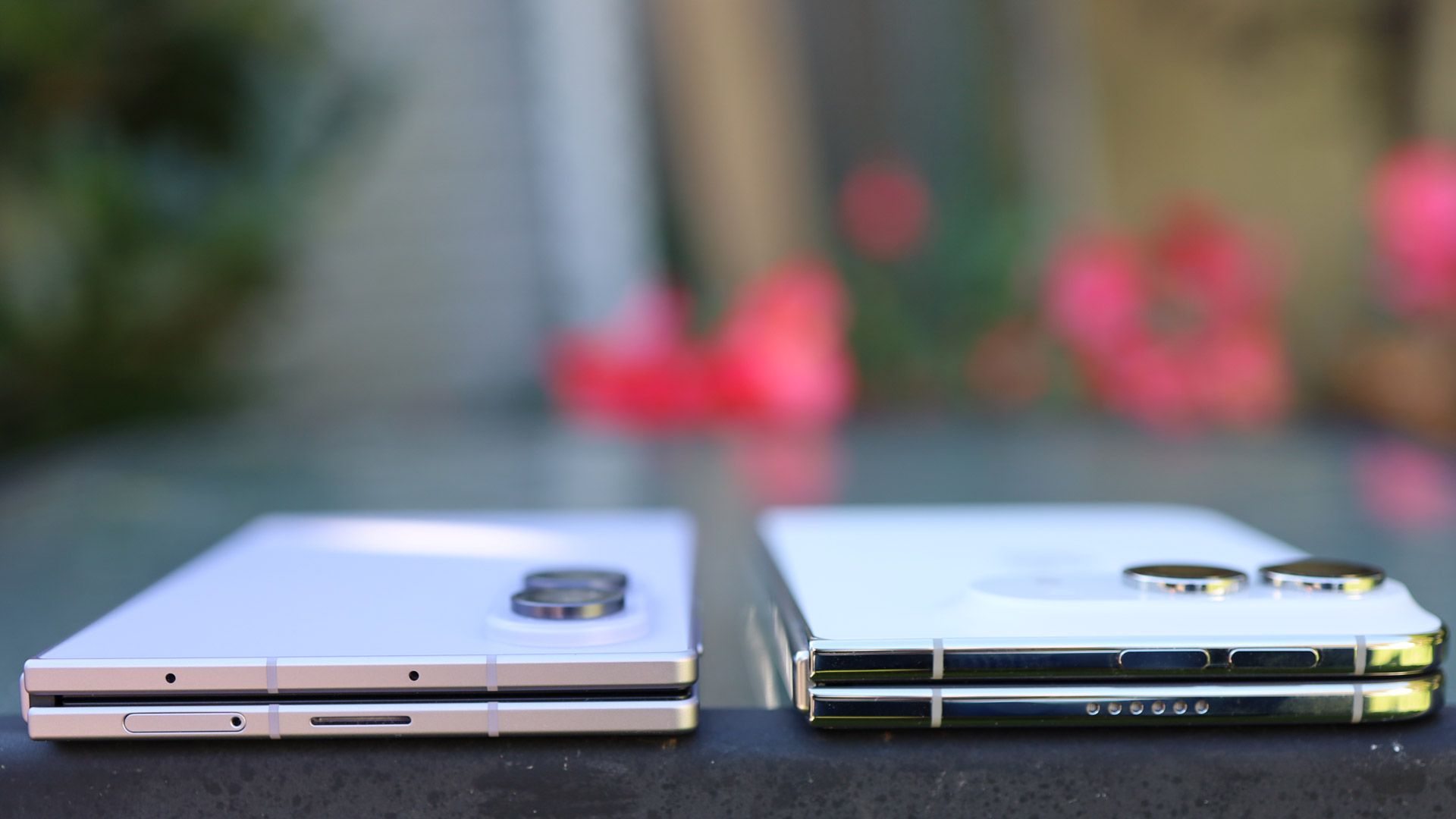
The iPhone Duo's design isn't a slam dunk, mainly because Apple built a foldable that is noticeably heavier and thicker than its nearest rival.
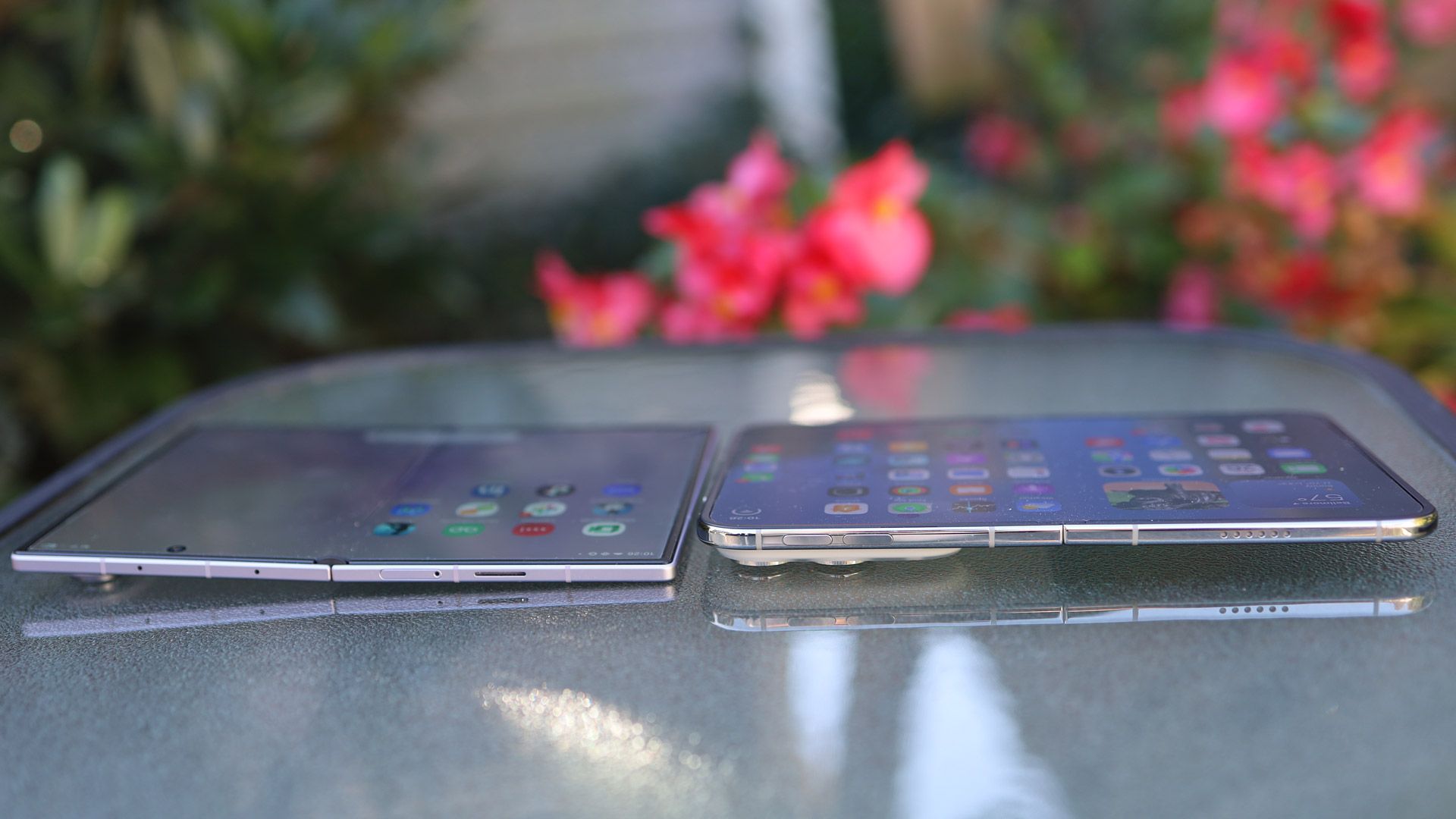
The Samsung Galaxy Z Fold 8 weighs just 201 g. The iPhone Duo weighs 254 g. That is a significant difference. Unfolded, the iPhone Duo is just 5.2 mm thick. That makes it the thinnest iPhone ever, but unfolded, the Samsung Galaxy Z Fold 8 is only 4.5 mm thick; folded, it's 9.7 mm, compared to the iPhone Duo’s beefier 11.3 mm.
Essentially, Apple has built a heavier and thicker device, and when I put the Folio case on it, I feel it in my pocket. I have not put a case on the Galaxy Z Fold 8, but when I have that phone in my pocket, I sometimes forget it’s there. That’s a big difference, and it’s clearly a win for Samsung and its Z Fold 8.
iPhone Duo |
Galaxy Z Fold 8 |
|
|
Dimensions: |
Unfolded: 164.6 x 117.8 x 5.2mm, Folded: 84.1 x 117.8 x 11.3mm |
Unfolded: 164.6 x 117.8 x 5.2mm, Folded: 84.1 x 117.8 x 11.3mm |
Weight: |
254g |
201g |
Displays: |
Main: 7.6-inch Super Retina XDR, Cover: 5.4-inch Super Retina XDR |
Main: 7.6-inch Dynamic AMOLED 2X, Cover: 5.5-inch Dynamic AMOLED 2X |
Resolution: |
Main: 1878 x 2670, Cover: 1398 x 2034 |
Main: 2448 x 1848, Cover: 1972 x 1248 |
Refresh rate: |
1-120Hz (main and cover) |
1 - 120Hz (main and cover) |
Peak brightness: |
3,000 nits |
3,000 nits |
CPU: |
A20 Pro |
Snapdragon 8 Elite Gen 5 for Galaxy |
RAM: |
12GB |
12GB, 16GB (1TB model only) |
Storage: |
256GB, 512GB, 1TB, 2TB |
256GB, 512GB, 1TB |
OS: |
iOS 27 |
Android 17 with One UI 9 |
Cameras: |
48MP wide (f/1.6), 48MP ultra-wide (f/2.2) |
50MP wide (f/1.8), 50MP ultra-wide (f/1.9) |
Selfie cameras: |
11MP Center Stage camera (f/2.2) outer, 4MP (f/1.8) inner |
10MP (f/2.2) inner, 10MP (f/2.2) outer |
Battery: |
4,800mAh (approximate) |
4,800mAh |
Charging: |
60W wired, 35W wireless |
45W wired, 20W wireless |
Colors: |
Star White, Night sky |
Lavender, Graphite, Cream, Mint (Samsung Store exclusive) |
Write in
It is worth noting that the Samsung Galaxy Z Fold 8 — like the Z Fold 8 Ultra — does give up something to achieve that thinness. It doesn't have a digitizing layer, meaning it cannot support an S Pen or a digitizing pen of any kind.
The iPhone Duo supports Apple Pencil. Granted, it's just one Apple Pencil right now: the Apple Pencil USB–C model. Why is that? Because you can’t charge an Apple Pencil by placing it on your iPhone Duo. You have to plug it in separately, charge it up, and then pair it. So it’s not perfect, but it does make the tablet side of the iPhone Duo even more useful.
I say this not just because it’s an opinion, but because it’s an experience I once had with Samsung’s Galaxy Z Fold line. The Samsung Galaxy Z Fold 6 was the last one to support the S Pen. It didn’t slip into the device, but you could buy a case/S Pen combo.
I loved having the ability to open up the device and just start sketching on it, because that’s the amazing thing about owning one of these foldables. They're true two-in-one devices — a phone and a tablet — in your pocket. So why wouldn't you want to draw on that tablet?
Yes, with either device you can use an analog stylus to draw, but digitizing pens that recognize pressure and angle are so much better.
Take a picture, it'll last longer
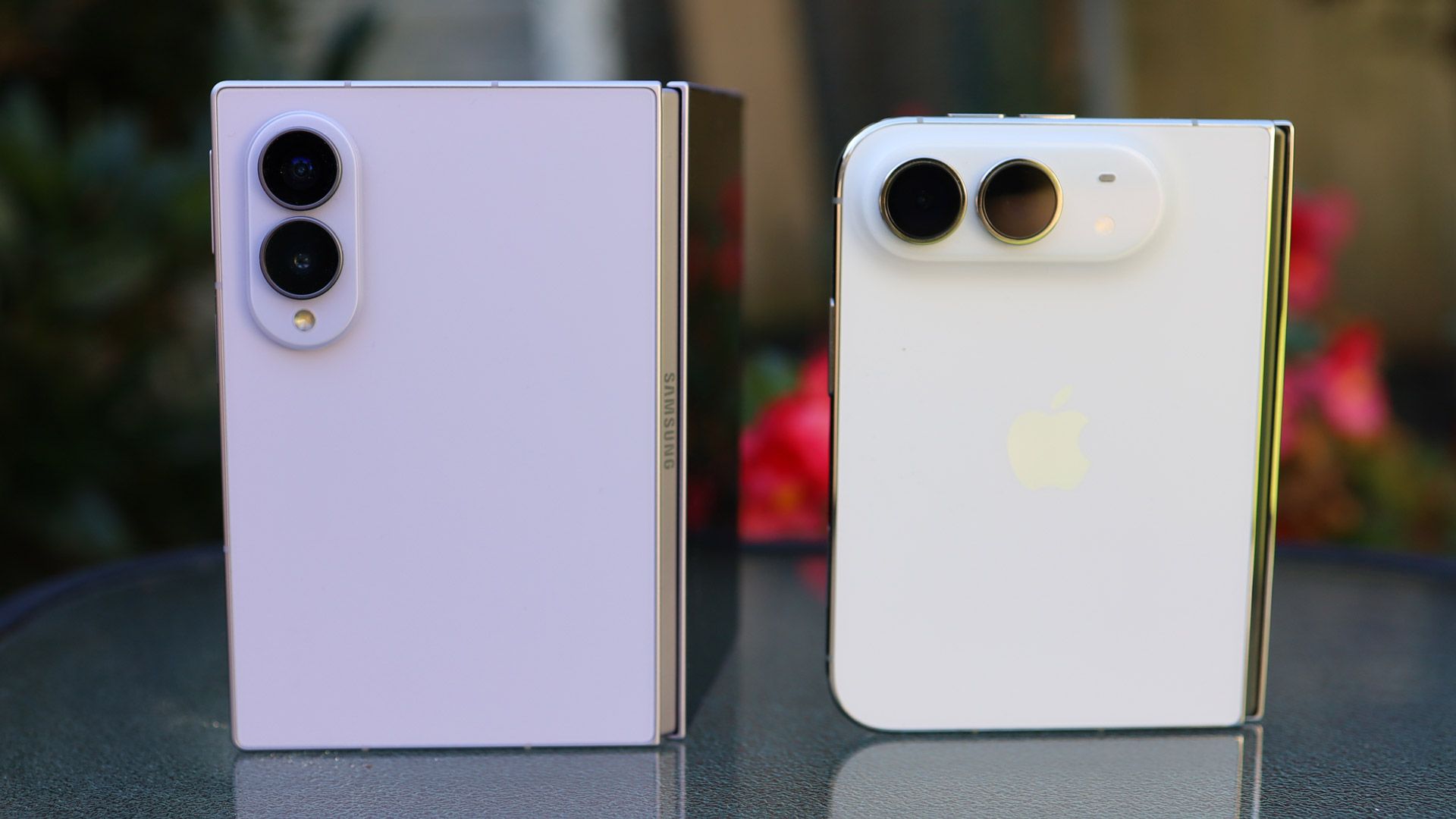
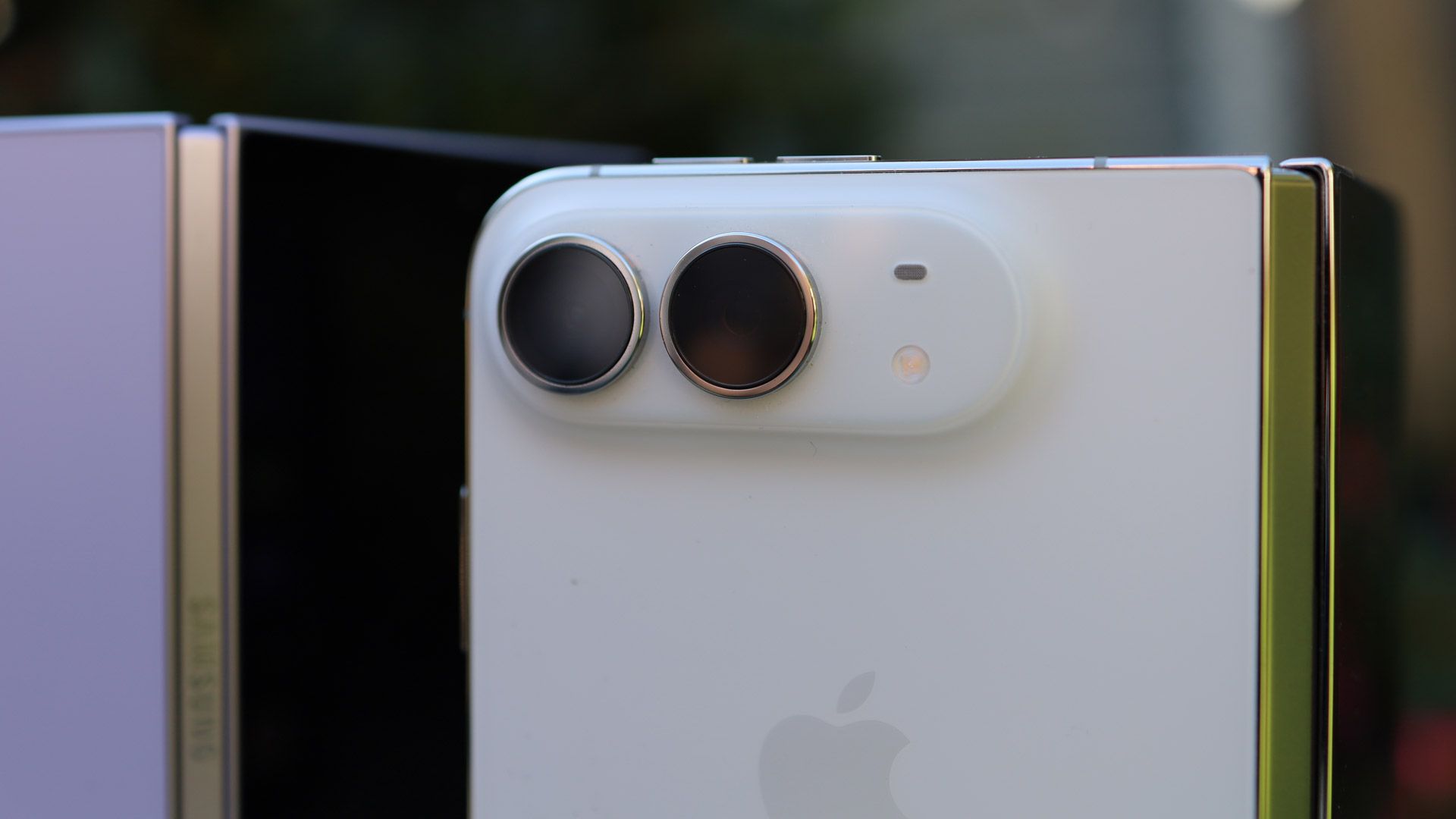
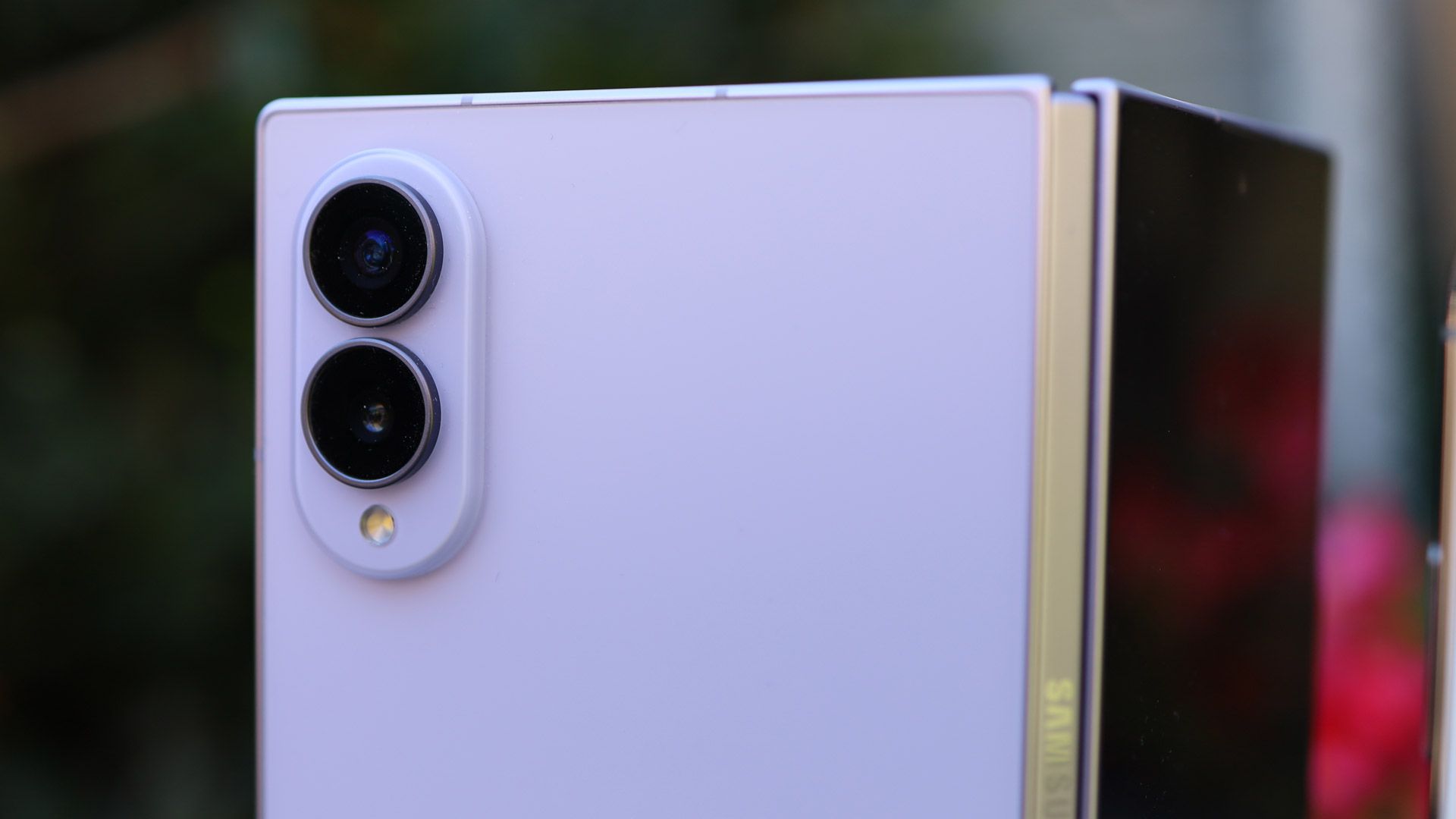
Okay, let’s talk cameras. This is an area where the two devices are quite similar. The Samsung Galaxy Z Fold 8 has a 50-megapixel ultra-wide and a 50-megapixel wide camera on the outside; the iPhone Duo has a 48-megapixel wide camera and a 48-megapixel ultra-wide. In my experience, the two-megapixel difference doesn’t make a difference.
 Lance Ulanoff / Future
 Lance Ulanoff / Future
They end up being comparable cameras, and the only real difference is how they’re positioned on the back of each foldable. I actually prefer the horizontal array on the iPhone Duo because, when you fold the phone and set it on a table screen-up, the Duo doesn’t rock around as much as the Galaxy Z Fold 8. Place that one screen-up on your desk, and it tends to rock on the camera array.
To see how the cameras compare, take a look at the slideshow below.
iPhone Duo vs Galaxy Z Fold 8 comparison
Comparing Ultrawide cameras on the passport-style folding phones


iPhone Duo vs Galaxy Z Fold 8 comparison
Comparing wide cameras on the passport-style folding phones


iPhone Duo vs Galaxy Z Fold 8 comparison
Comparing cameras on the passport-style folding phones


iPhone Duo vs Galaxy Z Fold 8 comparison
Comparing wide cameras on the passport-style folding phones
iPhone Duo vs Galaxy Z Fold 8 comparison
Comparing Ultrawide cameras on the passport-style folding phones


iPhone Duo vs Galaxy Z Fold 8 comparison
Comparing Ultrawide cameras on the passport-style folding phones

iPhone Duo vs Galaxy Z Fold 8 comparison
Comparing wide cameras on the passport-style folding phones


Both phones have a camera on the cover display.
The iPhone Duo has a 12-megapixel Center Stage camera, which takes great portrait mode photos (see below). The Samsung Galaxy Z Fold 8 has a 10-megapixel camera. Again, very similar differences, and almost not worth talking about.
How you feel about these shooters will come down to the style of photography you prefer. The Samsung Galaxy Z Fold 8, or Samsung in general, can tend to oversaturate pictures a bit, though less so on recent devices. Overall, you should expect excellent photography for both the iPhone Duo and the Samsung Galaxy Z Fold 8.
iPhone Duo vs Galaxy Z Fold 8 comparison
Comparing cover camera selfies on the passport-style folding phones


The inner display cameras take a turn.
The Samsung Galaxy Z Fold 8 has a real cutout for its 10-megapixel inner display camera, which is a good lens for selfies and video calls. By contrast, on the inside of the iPhone Duo, you have a hidden camera behind pixels that look a little different than the rest of the flexible display.
It’s not my favorite thing about the iPhone Duo, but even more so, I’m not thrilled that it’s just a 4-megapixel camera. That's fine for FaceTime calls, but it's not ideal for photography. So that’s an area where the Samsung Galaxy Z Fold 8 wins.
iPhone Duo vs Galaxy Z Fold 8 comparison
Comparing inner screen cameras on the passport-style folding phones


Tangentially related to cameras, the iPhone Duo lacks Face ID (you do get Touch ID) or a facial recognition camera. It's a big oversight for such an expensive iPhone. Samsung provides face unlocking, which basically makes it easier to unlock and access password-protected systems on the Galaxy Z Fold 8.
The software touch
Let’s talk a little bit about software.
Samsung’s been doing this a really long time, and it's clear that it's figured out the platform for a 2-in-1 device. The software never feels awkward. You get the full use of the space on both screens. On the iPhone Duo, it’s a little bit different because it can feel like Apple is still figuring things out in real time.
The iPhone Duo runs iOS 27, but it’s really a tablet/phone hybrid. The dock always sits vertically on the right-hand side, whether on the inner or outer screen. It has split-screen multitasking, but it supports a maximum of two apps — never the same app. You could have sort of a third thing going on with picture-in-picture, but I'm not sure that counts.
With the Samsung Galaxy Z Fold 8 and other Z Fold devices, you get three full apps: two side-by-side, and a floating screen on top. Still, it's only a 7.6-inch display, and I can't say how much use you’re gonna get out of that tiny third app. Things get a little crowded, but again, it just feels like Samsung has figured this out, and Apple is still working on it.
Let's talk performance: Apple’s iPhone Duo features the A20 Pro, and the Samsung Galaxy Z Fold 8 is powered by Qualcomm's Snapdragon 8 Elite Gen 5 for Galaxy. Both are excellent, efficient 2-nanometer mobile CPUs that help give you all-day battery life. The phones also have similarly sized batteries — in the 4800 mAh range.
In our benchmark testing, performance was very close, though Apple has the edge here. Both can do video editing (Apple shoots up to 4K video; Samsung ramps up to 8K). They both can play console-grade games. They both can browse the web, do email, and multitask. Performance is excellent on both sides.
With Apple finally jumping into the folding space, we are seeing developers play catch-up, and many apps still don’t look right on the inner screen, or even the main screen. Some do, and some are exceptional. Some developers have done really wild and silly things and built custom apps (Toastie, DeckMan, Tiny Computers), and we haven't seen that with Samsung. But Samsung’s been doing this so long that 99% of major app vendors seem to have figured out how to properly support their folding device on Android.
There's no doubt that Apple will catch up in this area because it’s early days, and Apple’s now committed to the folding space. We will see an iPhone Duo 2 maybe in a year or two, and by then we won’t really be talking about app support, though we may still be talking about Apple’s decision to put the dock on the side. I’m hopeful that by iPhone Duo 2 or iOS 28, Apple will have decided to give people more customization options, including letting them put the dock on the bottom.
Finally, we get to price. The iPhone Duo starts at $1,999 / £1,999 / AU$3,499 for the 256-gigabyte model, and the Samsung Galaxy Z Fold 8 starts at $1,899 / £1,699 / AU$2,699 for the 256-gigabyte model. With the Z Fold 8, you can go up to 1 terabyte, and with the iPhone duo, you can go up to 2 terabytes, though you’re gonna pay over $3,000.
These are expensive devices, and while I think people will use trade-ins, payment plans, or leases, none of them beats the others on affordability. When people ask about the overall value of these devices, I tell them that, as true 2-in-1 devices (phone and tablet), they're better values than you might think.
So, overall, who’s the winner? No one. Everyone. The truth is, I’ve struggled to decide which foldable I truly like better. I love that the Samsung Galaxy Z Fold 8 is a really thin and light device, but the iPhone Duo's virtually creaseless inner screen is a game changer. It is a beautiful phone and tablet. Yes, the Duo is a little heavier, and I don’t love that, but I think Apple will improve that over time too.
In the end, there is no winner. There is no loser. These are two excellent passport-style foldable devices. The iPhone Duo clearly appeals to iOS, Apple, and Apple ecosystem fans. They’ve been waiting for this. With the Samsung Galaxy Z Fold 8, Samsung introduced a new form factor that I think almost perfectly splits the difference between the bigger, taller Samsung Galaxy Z Fold 8 Ultra and the smaller Samsung Galaxy Z Flip 8. It's a content-consumption and productivity device that fits neatly in your pocket, and it does so more lightly than the iPhone Duo.
What I encourage you to do is take a close look at the specs of both, decide which lane you live in, iOS or Android, and then make your choice. I honestly think you’ll be happy either way.